An urban song, made in company
What makes a song belong to a city? An address cannot explain a musical form on its own. Neither can a single emotion. For fado, the Portuguese song tradition that brings poetry into a singer’s voice, the more revealing starting point is a set of relationships: between singer and listener, poetry and everyday life, familiar places and the people who gather in them.
The Museu do Fado, Lisbon’s museum devoted to this music, situates the genre in nineteenth-century Lisbon, describing performances in taverns, streets, gardens, and other places of leisure. It also records fado’s early association with socially marginalized settings and the rejection it encountered among some intellectuals. The form that later became a celebrated cultural emblem did not begin with universal recognition.[1]

This matters because heritage can appear inevitable when viewed from the present. Once a culture has museums, famous performers, and international recognition, it becomes easy to forget the choices and social judgments that shaped its route there.
Distinctive does not mean isolated
UNESCO describes fado as a synthesis of influences, including Afro-Brazilian sung dances, local song, rural musical traditions brought by migration, and cosmopolitan urban song. A solo voice is commonly accompanied by guitar and the distinctive twelve-string Portuguese guitarra. Fado was inscribed on UNESCO’s Representative List of the Intangible Cultural Heritage of Humanity in 2011.[2]
The compelling idea here is that cultural mixture and local distinctiveness can grow together. Influences do not arrive in an empty place. Performers and listeners select, adapt, repeat, and recognize them. Over time, the relationship among the parts can become more distinctive than any one ingredient.
Belonging need not depend on keeping every outside influence away. It can emerge through the particular way a community makes those influences its own. That is an interpretation of fado’s history, rather than a claim that every encounter works in the same way.

What travels, and what stays
The museum’s history follows fado into theatre, professional performance, recordings, and radio. These changed the scale of its audience and the settings in which it could be heard. The same history also describes the impact of censorship after the 1926 military coup. Its journey was shaped by institutions and political power as well as artistic invention.[1]
A broader audience creates a productive question: which relationships make a form recognizable when its setting changes? A recording can carry a voice far beyond a neighborhood. It cannot, by itself, reproduce every social connection that gave the performance meaning.
UNESCO’s account emphasizes learning across generations, including informal instruction in established performance settings.[2] That brings attention back to people: the knowledge needed to accompany a singer, interpret a poem, and recognize what a performance is doing. A living tradition needs opportunities to learn those things. Its future depends on being practiced as well as admired.
A neighborhood is more than scenery
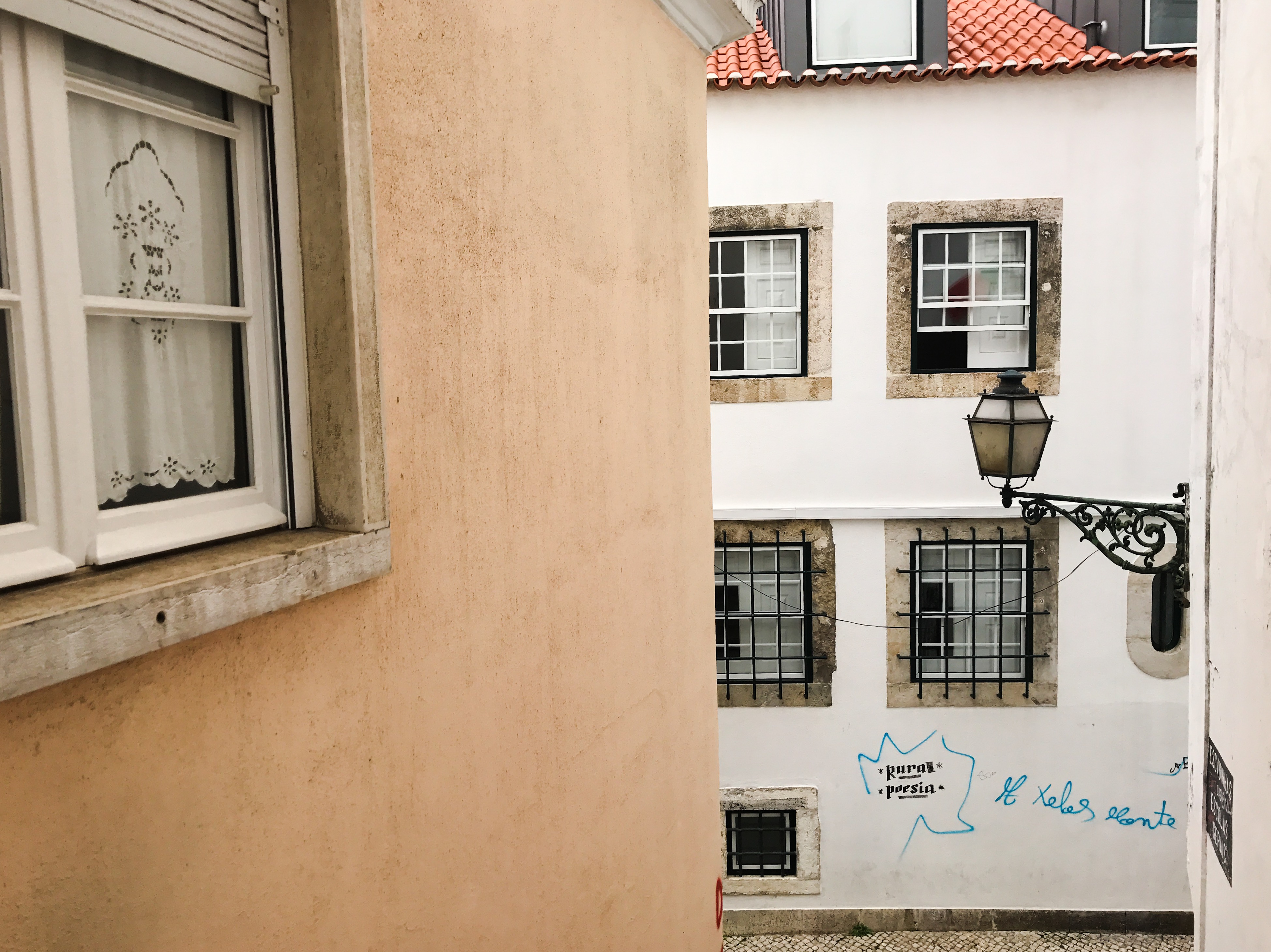
The streets of Alfama, a historic Lisbon neighborhood, are often used to introduce Lisbon visually, including the photograph accompanying this essay. That image locates a reader in the city; it does not document the sound or social setting of a fado performance. Architecture can suggest proximity and scale, but buildings alone do not explain why a musical practice continues. The activity inside and between them matters: gathering, rehearsing, listening, and recognizing a familiar repertoire, the body of songs shared by performers and listeners.
The museum's history describes a wide range of early performance settings, rather than a single birthplace that can account for everything fado became.[1] Keeping that range in view prevents one picturesque neighborhood from standing for the entire history. A city's culture moves through different rooms and institutions. Its geography includes places of ordinary leisure as well as the venues later identified with a recognized tradition.
Calling something local need not mean that it stays in one place or reaches only nearby people. Locality can describe a relationship maintained as songs circulate: a recognizable pronunciation, a repertoire, a way of accompanying a singer, or memories attached to a street. Those connections can remain meaningful for a listener elsewhere. What matters is how they are carried and acknowledged, not simply the distance a recording travels.
The cost of becoming an emblem
Recognition changes the way a cultural form is presented. A museum display, a commercial stage, and an informal gathering each give listeners a different frame. None tells the whole story. The museum's account of radio, recordings, theatre, and regulation makes clear that fado's public position was constructed through institutions and choices, not merely discovered once the world happened to notice it.[1]
A familiar image can be useful because it gives a newcomer an entry point. It can also become restrictive if performers are expected to reproduce it indefinitely. The difficult question is who decides what counts as a convincing continuation of the form. A tradition needs recognizable connections to its past, but it also needs people who can make decisions in the present. Admiration alone cannot settle that balance for them.
The same question applies to audiences. Listening respectfully involves more than looking for a performance that confirms an expectation of nostalgia. It means allowing differences among voices and songs to become audible. There is room to enjoy an emotional encounter while also being curious about its technique, authorship, and setting. That curiosity brings the singer back into focus as a maker, rather than an illustration of a national character.
Learning to hear the differences
Use the linked sound archive as a place to compare, not only to collect favorites. Begin with the named recording, listen without interruption, and then return to the opening phrases. How is the text paced? Where does the accompaniment become more noticeable? Which moments depend on a pause? These questions do not require expert vocabulary. They make attention more specific and help explain why two interpretations can feel different within a recognizable musical language.
Knowledge also passes through the repeated act of hearing someone more experienced. UNESCO's account emphasizes informal transmission across generations.[2] That gives preservation a practical meaning: people need situations in which the subtleties of performance can be encountered and tried. An archive can extend access to recordings, while living settings sustain the exchange through which musicians learn to respond to one another.
Fado's history leaves us with a more interesting idea of belonging than an unchanging sound sealed inside a city. A form can take in influences, reach new listeners, and still retain a distinctive vocabulary. Continuity comes through the choices of the people practicing it. Lisbon's voice is recognizable because those choices have been made, heard, and remade in company.
Listen to the city
Hear Amália Rodrigues sing “Ai Mouraria” in the Museu do Fado’s Digital Sound Archive. Select the recording to listen, then explore other voices in the collection.

A room is not a test of authenticity
James Patrick Felix's 2015 doctoral thesis examines authenticity through performers' and listeners' judgments. Its abstract distinguishes amateur commitment from professional payment rather than placing them at opposite ends of one scale. This challenges an easy shortcut: a commercial venue is not automatically inauthentic, and an intimate room does not by itself guarantee cultural authority.
- How did this performance setting develop?
- The museum's history of taverns, theater, recording and regulation. That one picturesque street contains the whole history. [1]
- How is the practice learned?
- UNESCO's description of informal transmission. That public recognition supplies teaching opportunities. [2]
- Who calls a performance authentic?
- Felix's distinction between payment and personal commitment. That ticket price settles the question. [3]
With the linked Amália Rodrigues recording, listen first to the voice's pacing, then return to the same passage and follow the accompaniment. Where does a pause leave room for an answer? This gives a specific performance priority over a general claim that all fado expresses one emotion. It is an invitation to compare what can be heard, not a transcription or a substitute for understanding the poem.
Sources & further reading
- Museu do Fado. Fado History.
- UNESCO. Fado, urban popular song of Portugal.
- James Patrick Felix. Folk or Fake: The Notion of Authenticity in Portuguese Fado, University of Leeds doctoral thesis (2015), abstract.