A parade with a social foundation
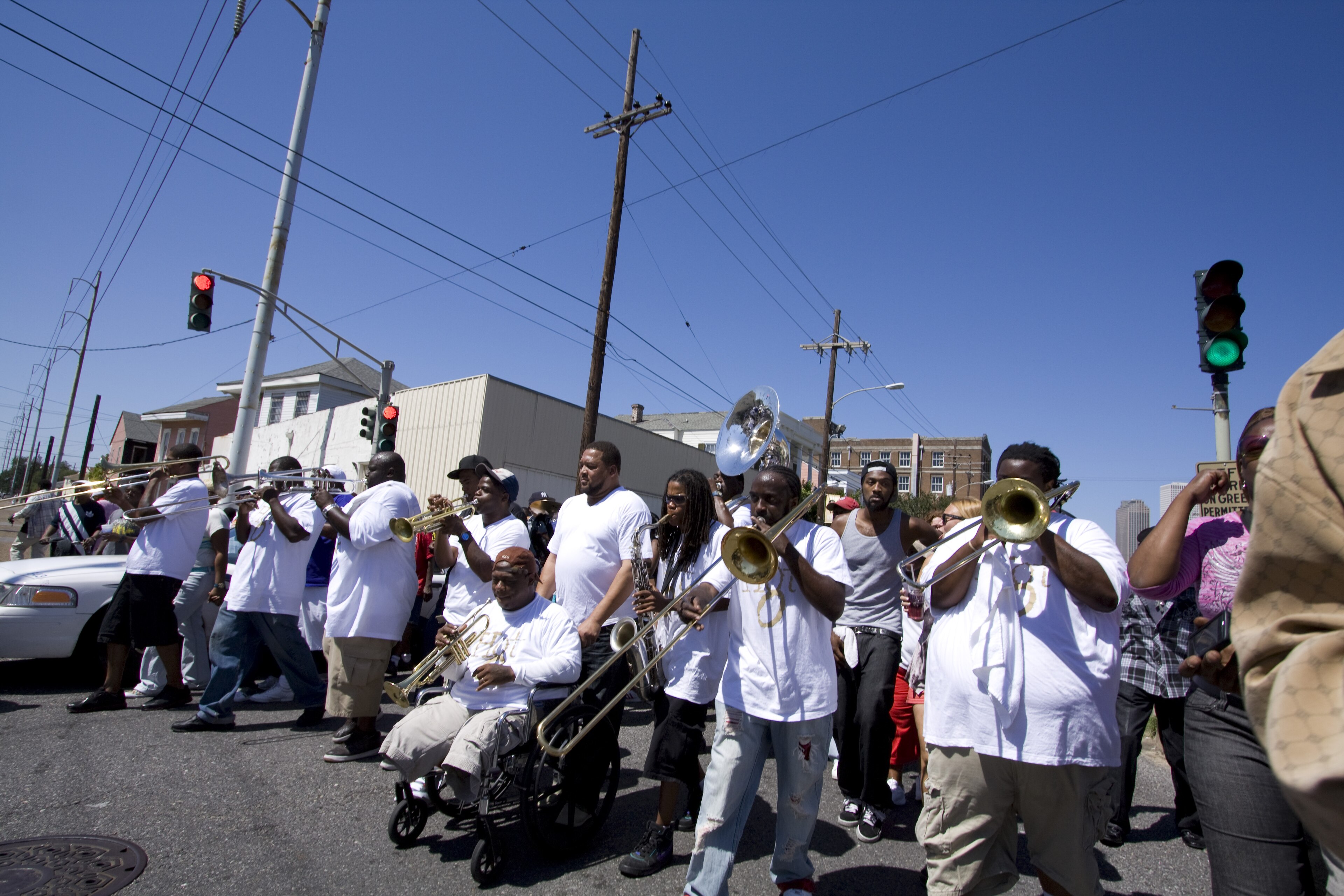
A second line, a New Orleans parade whose followers dance behind a club and its brass band, makes an unusual proposition: the life of a neighborhood belongs in the street. Brass instruments, coordinated clothes, dancing feet, and a gathering crowd turn a route through the city into a shared occasion. The spectacle is immediately compelling. Its underlying social structure deserves just as much attention.
New Orleans’ social aid and pleasure clubs developed out of a world of benevolent associations. These organizations helped members with the costs of illness and burial while also making room for sociability and celebration. The city’s tourism organization traces that connection explicitly: mutual support and a good time belonged to the same institution.[1]

That pairing changes how we might read the parade. The clothes and music express a relationship that exists beyond the performance. They make membership visible. A person can be recognized as a neighbor, a participant, and someone worth showing up for.
How the street became a stage
The National Park Service places social aid and pleasure clubs within the everyday networks that helped early jazz develop: neighborhood halls, dances, picnics, and other community gatherings. It distinguishes the society members and their hired band from the people following along, the participants who became known as the second line.[2]
This is a different relationship between artist and audience from a fixed stage facing seated spectators. People can join a moving event. The route itself connects the performance to the surrounding neighborhood. The street provides more than a backdrop; it allows a cultural form to assemble a public.
Participation can help a tradition renew itself. A parade offers many ways to belong, from playing and organizing to dancing and simply coming along. Repetition can make those roles familiar without requiring every performance to be identical.
The work behind the joy
The Historic New Orleans Collection’s exhibition on these clubs foregrounds people who sustained the culture through many overlapping roles. Ronald W. Lewis, for example, was a club founder, artist, historian, and collector who established the House of Dance and Feathers in the Ninth Ward. His work connected participation with the task of keeping a community’s memory.[3]
That work continues in organizations such as the Original Big 7. Established in 1996 in the Seventh Ward, the club describes its purpose through youth programs, community, and its Mother’s Day second line. Its Little 7 Players Club gives young people a place within the tradition.[4]
These details point to the conditions that make continuity possible: organizers, relationships, opportunities for young people, and spaces where knowledge can be practiced. Celebrating the parade means paying attention to that quieter work too.
Joining without taking over
The distinction between the first and second lines is useful for anyone encountering the tradition for the first time. The official group and contracted band give the procession its organized center; the followers contribute another layer of movement and response. Joining does not mean that everyone has the same role. An open event can welcome participation while retaining the authority of the people who planned it and the community from which it comes.
This makes listening a social practice as well as a musical one. A person can attend to the band, the dancers, and the movement of the procession without expecting the event to reorganize around a visitor. The strongest encounter begins with curiosity about what is already happening. It asks who is hosting, what the occasion means, and where its boundaries lie. Respect for those distinctions makes participation richer, not less enjoyable.

An image of a parade can capture a gesture or an outfit. It cannot show the full history of membership behind that moment. A photograph should therefore be an invitation to look more carefully, rather than evidence that the viewer now understands the whole event. The specific band, club, date, and occasion matter. Naming them prevents a living practice from collapsing into an interchangeable picture of local color.
Memory belongs to its makers
The Historic New Orleans Collection's 2021 exhibition brought parade clothing and objects into conversation with photographs and accounts from participants. Its collaboration with the Neighborhood Story Project included club members' explanations of the objects on display.[3] That approach treats regalia as something made and used by particular people, rather than as decoration detached from its owners. An outfit carries decisions about how a group wants to be seen.
Community museums also raise a question about who gets to preserve that knowledge. Collecting can happen close to the people and streets represented, not only in a large institution elsewhere. The work of documenting a parade can sit beside the work of taking part in it. A person who knows why an object was made may preserve a different kind of memory from someone who can describe only its materials or appearance.
Original Big 7 presents youth participation as part of its own continuing work.[4] The important point is the relationship between generations. A young participant needs more than a finished archive to look at. They need people with whom to practice, opportunities to contribute, and room to develop a role. Transmission happens when knowledge becomes usable, and when responsibility can be shared rather than remaining with one generation alone.

What to listen for
The linked recordings offer a first encounter with the music without standing in for the experience of a procession. Listen once for the repeating pulse, then again for the exchanges among instruments. Notice how a musical phrase can leave space for a response. A recording allows that kind of concentrated attention; a moving public event adds bodies, changing surroundings, and the decisions of people sharing the street.
Preserving second-line culture therefore involves more than preserving a repertoire. It means making room for the associations and relationships that give a parade its occasion. The brass band, the club, and the followers are connected parts of that public life. The city dances together because people do the work of bringing it together, and because others recognize that gathering as something worth continuing.
Listen to the city
Hear Liberty Brass Band’s “Paul Barbarin’s Second Line” and Hot 8 Brass Band’s “Keepin’ It Funky” on Smithsonian Folkways’ New Orleans Brass Bands collection. Listen for the parade rhythm and the different ways the bands carry it.
Follow a club, a route, and a band
The sources describe different kinds of participation. Keeping them separate explains why an open parade can still have a particular organizer, purpose and history. Original Big 7's account is evidence of that club's priorities; the museum's exhibition documents a wider history. Neither alone measures every club's present finances.
- Original Big 7 and its Little 7 Players Club
- Youth participation is organized, not simply inherited. The staffing or income of other clubs. [4]
- Ronald W. Lewis and House of Dance and Feathers
- A participant can also collect and interpret community history. That a museum can replace everyday participation. [3]
- The club, hired band and following second line
- The event joins people whose responsibilities differ. That every follower is a club member. [2]
On the linked brass-band collection, compare the repeating pulse with the entries above it. Follow one instrument through a return of the pattern, then listen to how another answers. Treat this as a listening exercise, rather than a claim that a recording reproduces a particular procession. To learn about a parade, return to its named club and occasion as well as its sound.
Sources & further reading
- New Orleans & Company. Social Aid and Pleasure Clubs.
- National Park Service. Jazz Origins in New Orleans.
- Historic New Orleans Collection. Dancing in the Streets.
- Original Big 7. Club history and youth programs.