In November 2025, the kite made by Las Orquídeas did not fly. The women had spent months preparing it; on the festival field in Sumpango, neither of their permitted attempts succeeded. Prensa Comunitaria recorded the disappointment alongside the work that followed: repairing the kite and keeping designs for future exhibitions. Twenty-two women had made something together. A failed launch would not be the last thing they did with it. Prensa Comunitaria1
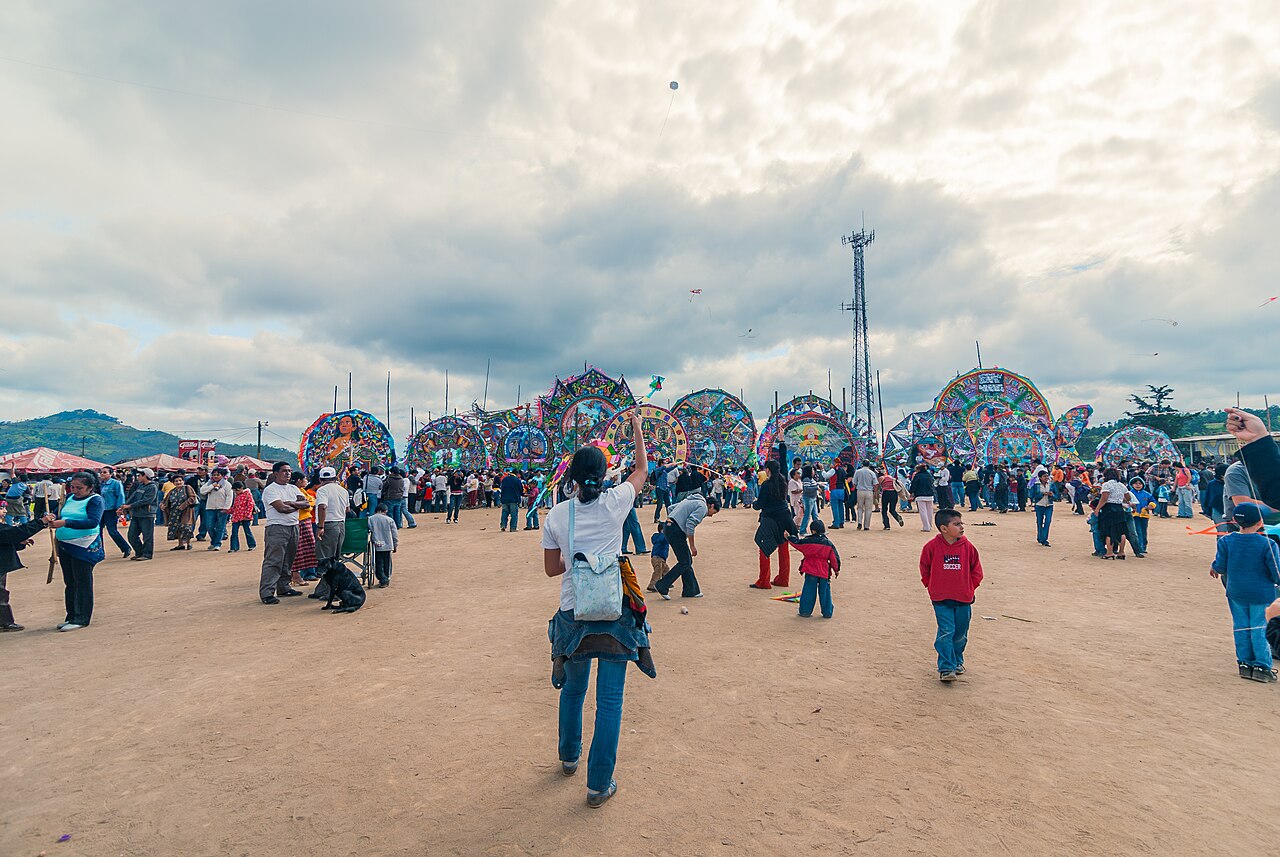
Every November 1, this town in Guatemala’s Sacatepéquez department brings out its barriletes gigantes for All Saints’ Day. Some are made to fly. The largest are raised for display, towering over their makers. Their images address ancestors and neighbours, the dead and the urgently living. For a visitor, the festival begins with the finished face of a kite. For Sara Xicón and the women of Las Orquídeas, it begins much earlier, with finding hours in lives that are already full.
It is worth looking at that face slowly. What appears from a distance to be a painting is often a construction of many small pieces of coloured tissue paper. Scale creates the first astonishment; the second comes from understanding how it was achieved. Someone cut the edge of that figure. Someone worked out how one colour should meet another. Someone carried on after a day spent doing something else. Revue’s account of the craft describes overlapping paper used to produce shading and fragile pieces placed with small applications of glue.2[2]
Paper makes the scale deceptive. A figure that reads clearly from across a field has to be assembled at arm’s length. The makers spend far longer looking at its fragments than an audience will spend looking at the whole. By November, they know it through its difficulties: where pieces must meet, which section still needs attention, how much remains to be done.
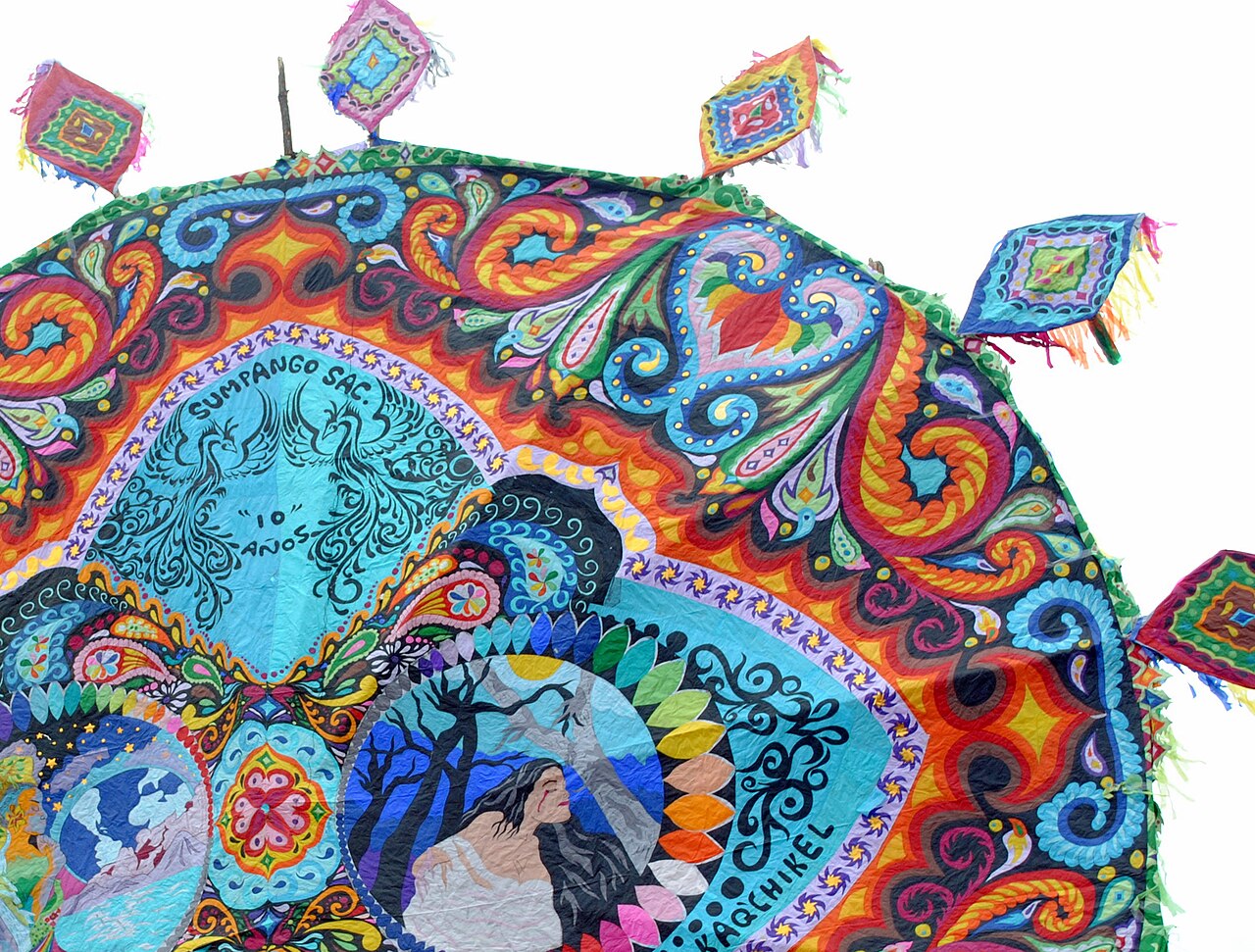
Sumpango and nearby Santiago Sacatepéquez are predominantly Maya Kaqchikel communities. Guatemala’s culture ministry describes the kites as connections with ancestors, understood as people with whom relationships continue after death. The November gathering brings that understanding into the calendar of All Saints’ Day. The result belongs to particular communities and their histories. It deserves more attention than a passing comparison with the better-known Mexican celebrations of the dead. Guatemala Ministry of Culture and Sports3
Remembering someone is often described as an inward act: a thought, a name, a private feeling. Here remembrance also takes up room. It requires a place to work and a place to gather. It gives people something to carry, assemble, and show one another. A relationship that cannot be resumed in ordinary conversation acquires a material task.
The town’s contemporary festival also has a history within living memory. According to the organising committee, young residents came together in 1977 after the destruction caused by Guatemala’s February 1976 earthquake. They organised cultural and sporting activities. In 1978, concerned about declining participation in kite-making, they established a competition beside the cemetery. The competition developed into the much larger festival. Festival committee history4
The competition gave young people a reason to return to the work and an audience to prepare for. Its organisers were responding to a worry many families recognise: what happens when something that mattered to the older generation stops drawing the younger one? They could not oblige people to care. They could create an occasion in which caring had company.
The committee records another, harder detail: in 1979, threats during Guatemala’s internal armed conflict prompted the organising group to change its name. Even the work of arranging recreation and cultural gatherings could become politically exposed. Set beside the kites’ colour, that history complicates the idea of a festival as an escape from everything outside it. Gathering people has its own stakes.
The making begins with a proposal. A group chooses what its kite will communicate, works out a design, and translates it into a scale large enough for public display. The ministry’s description follows the process through reinforcement, a cane or bamboo support, fringes, and the assembly of the surface with its frame. Blessings and ceremony accompany parts of the material preparation. Engineering and spiritual purpose occupy the same undertaking.
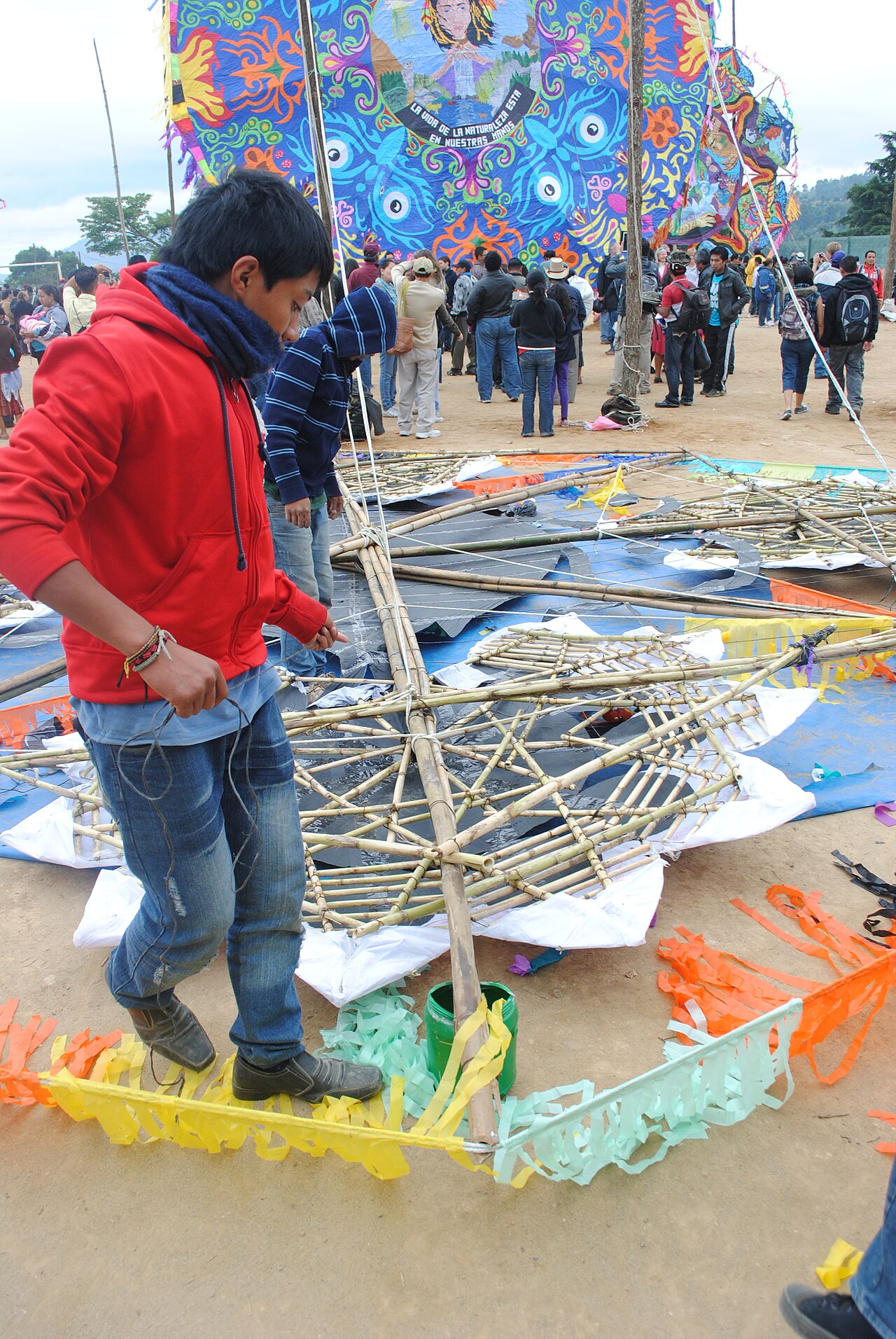
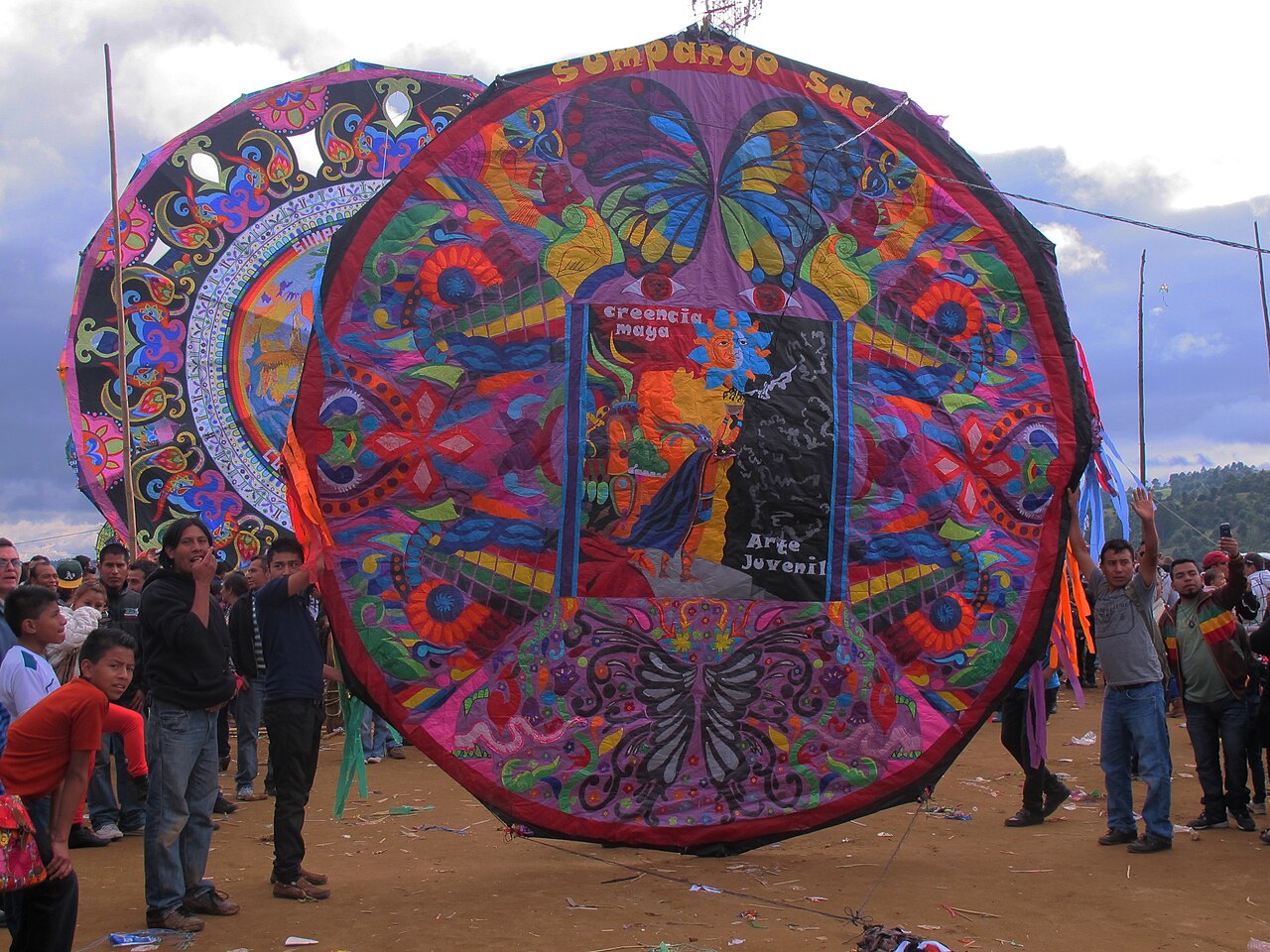
A successful image has to work at several distances. Up close, a maker sees joins and small shapes. Across the field, a spectator needs to recognise figures and read the overall composition. That is a demanding design problem. It asks a collective to imagine the completed whole while much of the work remains in pieces.
The themes are firmly contemporary. Documentation of the practice records designs addressing the environment, violence, and human rights, alongside the relationship with ancestors. The work travels through committees and intergenerational participation, with people learning by helping to make and present the kites. Documentation of the kite-making tradition5
That combination makes sense. To remember previous generations is also to consider the world being handed to the next. Environmental destruction or violence is not an interruption of cultural memory. It can be precisely what a community wishes to discuss through it.
A kite’s message is unusually public. It does not wait for someone to turn a page or enter a gallery. Once raised, it occupies the shared view. People can admire the workmanship and disagree about the proposition. A festival field can therefore become a place where beauty attracts attention to an argument.
The question of who gets to make that argument has changed too. Las Orquídeas, a women’s kite-making group founded in 1999, made participation itself part of the story. In a 2019 photo essay, Sara Xicón explained the group’s challenge to expectations about women’s proper place. That year, its younger participants worked on a design about technology consuming people’s attention. Vogue’s 2019 report6
A 2022 visit by No Ficción found how those ambitions fitted into ordinary working lives. Sara embroidered and helped run the family shop. Saida Cay worked outside Sumpango during the week. Flor de María Mázate combined a job with studies in music and singing. Katerin Jazmín Xicón was ten. When they gathered around the paper, the differences in age and daily responsibility became part of the company. Saida described the group as somewhere she could loosen the hold of problems at home and express herself through making. No Ficción7
By September 2025, Prensa Comunitaria reported, the women met three nights a week, then daily in the final fortnight. Thirteen-year-old Katerin was the youngest member; Sara’s eldest daughter, Marisol, directed the work. Across successive reports, a child grows older inside the group and a daughter takes responsibility.
The failed flight belongs beside those evenings. From outside, it is easy to measure a kite by whether it rises. From inside a collective, there are other tests: whether everyone came back, whether a difficult section was finished, whether someone younger can now do a job that once required help. None removes the disappointment. They explain why disappointment need not end the undertaking.
Sara has also prepared for a day when she may not be there to direct it. In reporting published by Contracorriente in 2026, she described practice flights ahead of the festival, with her eldest daughter taking the lead. The group rehearses assembling the kite, carrying materials, and pulling together. Knowing how to make it is only part of the task; someone must know how to lead other people through the crowded, exposed moment of raising it. Contracorriente8
That preparation gives succession a practical shape. Passing something on can sound like a gift completed when a parent teaches a child. Here it also requires stepping back enough for the next person to practise responsibility. A daughter needs more than the memory of watching her mother. She needs a chance to make decisions while the mother is still close enough to help.
Sara told Contracorriente that women had once been expected mainly to prepare breakfasts and refreshments for kite-makers. Her aim was to put them inside the making. The group asks for commitment rather than a membership payment; obtaining materials has depended on family contributions and small amounts of support. A place at the worktable must be made possible as well as offered.
Local reporting in 2024 captured the importance of each group choosing a theme and developing a new design. Byron Pescado of Corazón de Maíz described the annual novelty of the work; the festival gives returning visitors different images to encounter. Prensa Libre9
That distinction may be why the festival can hold both inherited belief and current debate. The form supplies familiarity without requiring identical content. People recognise what is happening, while remaining curious about what the makers have chosen to say this time.
Learning takes place across the surface. A beginner can see whether a piece fits and whether a join needs attention. But the invitation is larger than a lesson in paper. A girl who contributes a small section can later find it inside something large enough to command a field. Her work has acquired a public life.
The group’s subjects can be painfully specific. Sara told No Ficción that one design commemorated the 41 girls who died in the Hogar Seguro children’s home fire. The women put faces or silhouettes onto the kite. The memorial joined their grief and anger as women to an occasion for addressing the dead. This was a choice about whose lives should remain visible, made by people prepared to spend their evenings giving the choice a form.
That changes how a visitor might look. The first question need not be what every symbol has always meant. It can be whom these makers want people to remember this year. The answer may lead away from a timeless explanation of custom and towards a wound in the recent life of the country.
The distinction between Sumpango and Santiago Sacatepéquez matters for the same reason. Both towns are associated with giant kites, but naming them separately preserves the possibility of difference. A regional practice is made in actual places, by groups with their own memories and choices.
A photograph can preserve the colour and scale. It cannot preserve the entire reason someone came to the worktable after a difficult day. Some contributions are visible as paper; others are the attention people give one another while their hands are occupied. The collective offers a way to speak without making conversation the only task.
There is room here for enjoyment as well as duty. Working alongside people who know the same deadline can make exhaustion companionable. An undertaking can be demanding and still be the part of the week that someone most wants to reach. Remembering the dead does not require the living to stop taking pleasure in one another.
The festival’s date returns whether a particular kite flies or fails. Its makers must decide again whether they can find the time, gather the materials, and agree on what they want to say. The renewed commitment is less photogenic than the completed circle of paper. It is also the part no spectator can supply for them.
Las Orquídeas repaired their kite. They could not redo the festival’s moment, but they could put their hands back to the thing they had made. The design remained worth keeping, and they still had reasons to gather around it.
A collective seen at different moments
The successive reports on Las Orquídeas permit a small chronology. They should be read as observations made by the credited publications, with gaps between them. A participant's appearance in one report does not establish that she held the same role in every year.
- Vogue, 2019. Sara Xicón's account of challenging expectations and younger makers' design work. This is not the 2025 launch. [6]
- No Ficción, 2022. Different ages, jobs and reasons for gathering. The collective is not one anonymous biography. [7]
- Prensa Comunitaria, 2025. Preparation, leadership and the unsuccessful flight. Failure to fly does not erase the completed design. [1]
- Contracorriente, 2026. Sara's account of rehearsal and succession. A report date is not automatically the date of every event recalled. [8]
The chronology shifts the question from whether a kite flew to how people kept making work together. Both questions matter. It also makes the limits of the archival photographs clear: the images illustrate materials and festival settings, while the publications establish the named women's experiences.