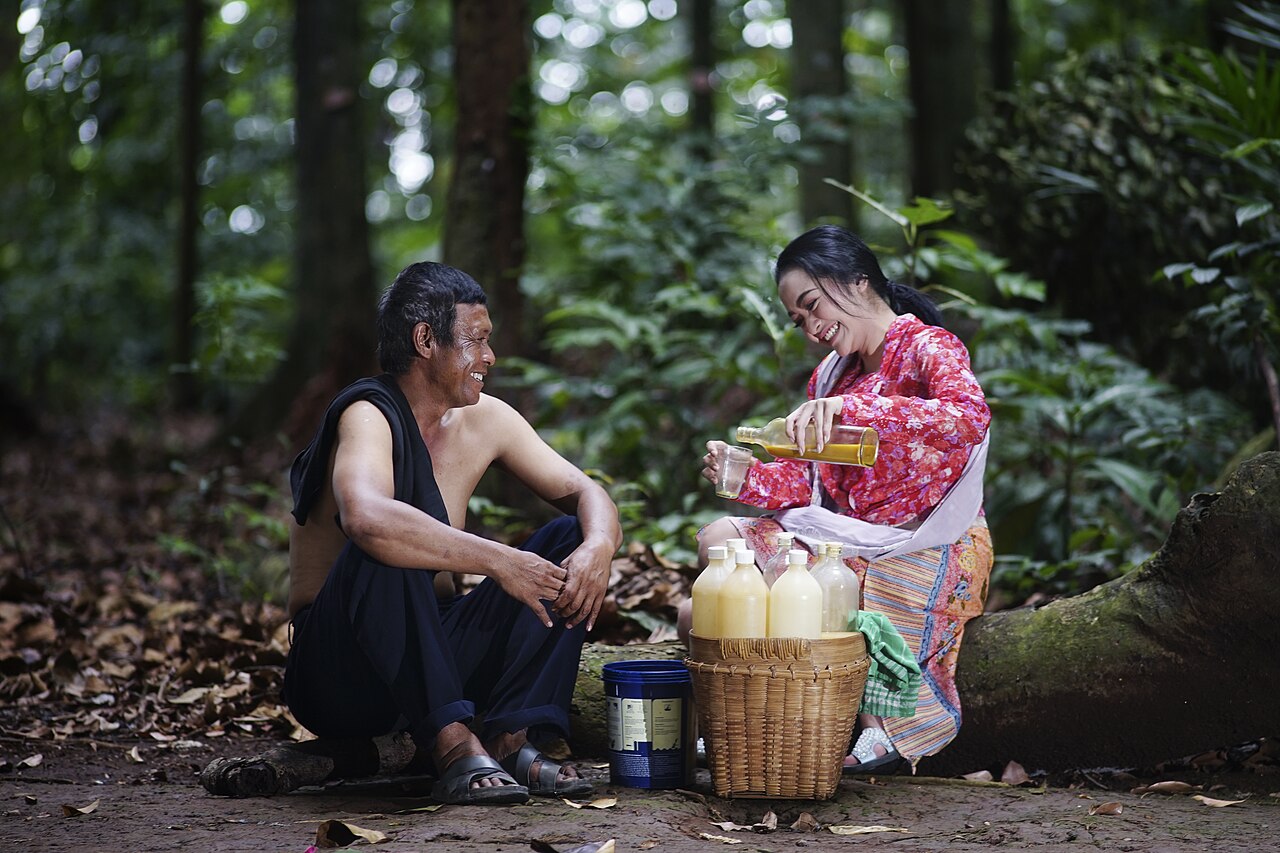
After Giyem was widowed, a friend offered to teach her to sell jamu. She needed to support her children; the work gave her a way to begin while still grieving. Years later, her daughter Mulatsih entered the same trade. In Vogue’s 2023 account, a family skill began with one woman recognising that another needed help. Vogue1
Mulatsih begins preparing jamu around 4am, according to photographer Nyimas Laula’s 2024 account. The Guardian2
For the customer, a drink can be a small pause before the day begins. For the seller, that pause arrives inside a working day already under way. The difference in their clocks is easy to miss. Someone’s familiar morning comfort depends on another person having started earlier.
Jamu is a broad Indonesian tradition of herbal preparations, not the name of one fixed drink. Roots, rhizomes, leaves, and other ingredients enter different recipes. People associate those preparations with maintaining wellbeing and responding to particular bodily concerns. The cultural practice includes growing and obtaining ingredients, making mixtures, distributing them, and deciding what to take. Documentation of jamu culture3
A customer may know the preparation they want by taste, name, or habit. That familiarity can make the drink seem simple. But “jamu” covers many mixtures and ways of making them. Knowing one does not mean knowing them all, just as recognising a finished colour does not mean being able to assemble the ingredients that produce it.
Central Java gives the story a particular location. Around Sukoharjo, jamu-making connects households with a substantial trading network. The seller at a customer’s door is the visible end of a longer chain of people and knowledge.
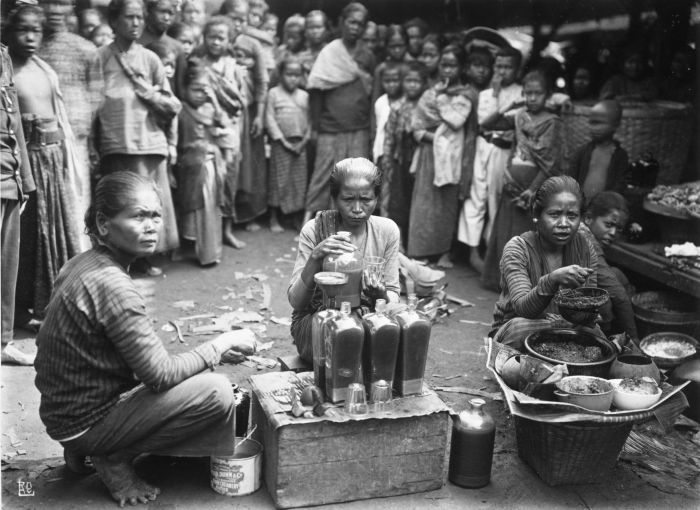
At Nguter market, that chain can be encountered in the materials themselves. A study conducted from December 2022 to January 2023 interviewed 36 herbal-medicine traders and recorded 40 plant species from 23 families being sold. The findings describe one market at one period, but they give useful substance to the word “herbal.” It refers to a working inventory of distinct plants. Asian Journal of Ethnobiology4
Those distinctions are practical. A request at a stall has to become the right material in a bag. A maker must be able to recognise what she needs before it is ground or mixed beyond recognition. The market holds that knowledge in separate piles and transactions, long before a customer encounters it as a glassful.
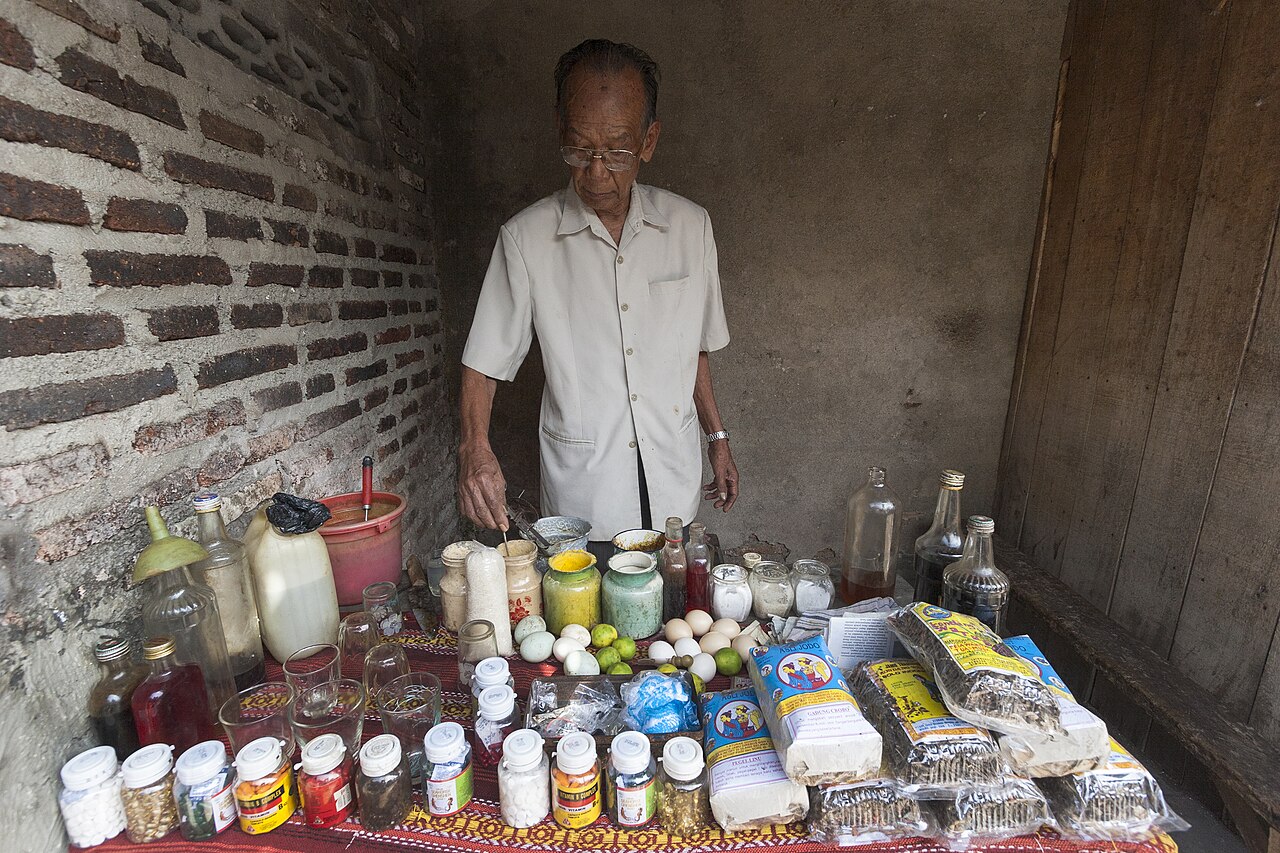
That division of labour makes the market an important part of the knowledge system. A recipe does not become a drink through memory alone. Someone has to be able to find the right materials and recognise what is being sold.
At Nguter, Vogue met Yatmini, who had sold supplies since 1965. Eighty at the time of the report, she still wanted to work among family and friends; her daughter Sunarmi would eventually inherit the stalls. The market was somewhere to earn money, but also somewhere she wanted to be.
The same reporting followed Pariyem’s progression from carrying jamu on her back to a bicycle and then a motorbike. That change has a bodily meaning. Moving stock takes effort before any sale occurs. A different vehicle can alter the distance a seller can cover, what she can carry, and how much of herself the journey consumes.
The term jamu gendong remains closely associated with women who carry and sell preparations. Yet the cultural importance of the seller cannot depend on her retaining the most physically demanding version of the job. A practice is alive partly because its practitioners can improve their working day.
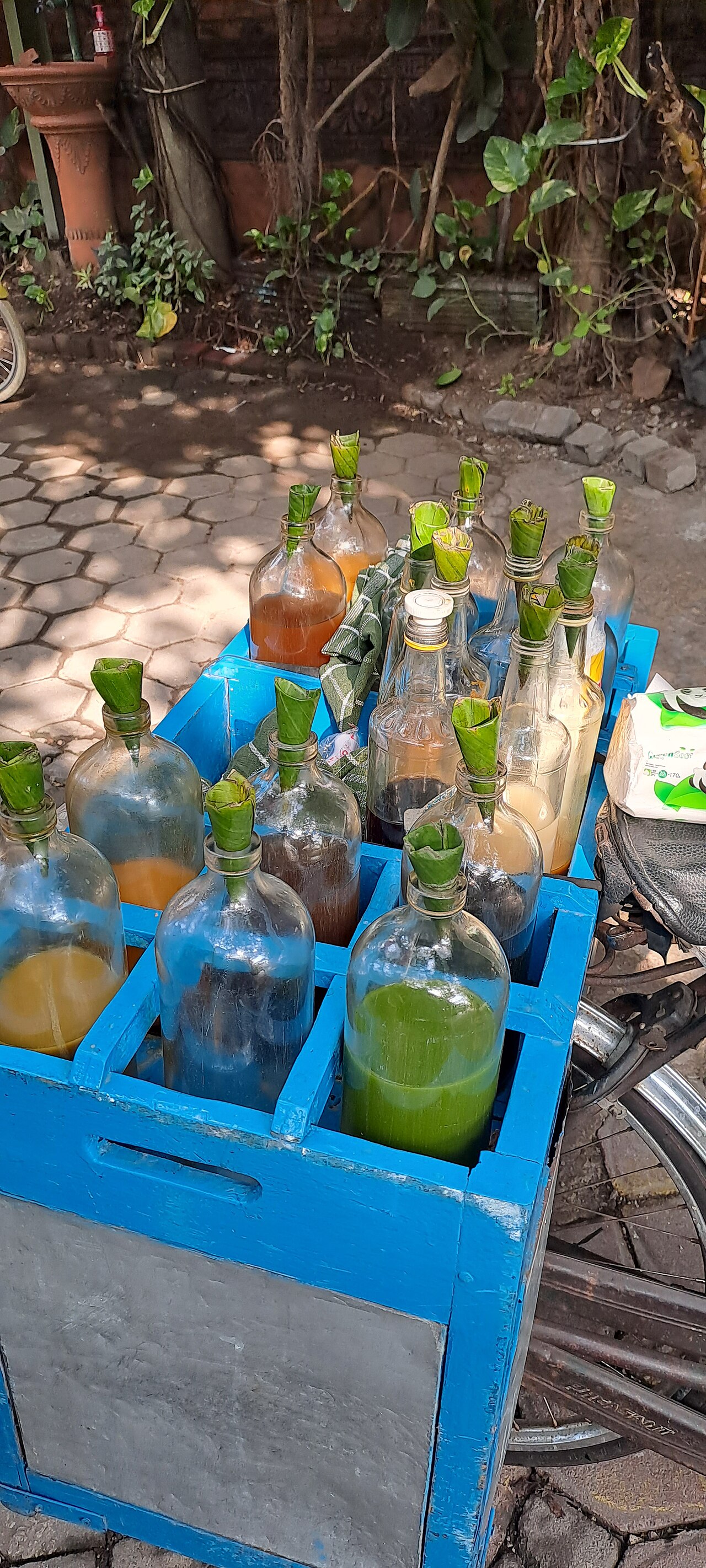
The familiar image of the woman with bottles can make the occupation look like something she has always known how to do. But someone had to teach her. A useful preparation depends on choices made repeatedly and competently. The more dependable the work becomes, the easier it is for a customer to stop seeing the skill inside it.
The woman serving has to balance that exchange with the rest of her work. Stock is prepared before its buyers are certain. Conversation can be welcome, but there are other customers to reach. A glass pays towards ingredients, preparation, travel, and the time spent selling. The price must sustain a whole sequence, even when the buyer sees only the pour.
The sociability of the work should therefore be understood alongside its business requirements. Warmth and commerce can coexist. A woman does not become less caring because she needs her customers to pay, and her labour does not become less skilled because the exchange happens outside a formal shop.
Historical research places women’s herbal trade within a much longer working history. A study of Yogyakarta between 1910 and 1930 describes women selling remedies and ingredients during the Dutch colonial period, when access to Western medical services could be expensive and geographically difficult. Historiography: Journal of Indonesian History and Education5
That context complicates a simple account of consumer preference. People make choices within the services, prices, and relationships available to them. The history of a familiar preparation can also be a history of who had access to other forms of care.
A younger generation has also had to negotiate what other people think the work should look like. In a 2019 Jakarta Post interview, Sunita Bhagchandani recalled customers questioning why a business graduate of her age would choose a traditional market. Her days began early, in a T-shirt, rather than in the office clothes they expected. Her mother came from Surakarta, and childhood jamu drinking had helped draw her towards the business. The Jakarta Post6
Anthropologist Margot L. Lyon’s account in Inside Indonesia describes the growth of packaged preparations and large manufacturers alongside itinerant sellers. It traces businesses that began as family enterprises, changing retail networks, and marketing aimed at different customers. The article’s details belong to the period it discusses, but its larger observation remains useful: jamu has a commercial history of adaptation. Inside Indonesia7
A sachet and a freshly prepared glass organise trust differently. One offers a brand, package, and repeatable presentation; the other may place greater emphasis on the person making and serving it. Neither distinction alone settles questions of quality.
Bhagchandani’s business was based outside Central Java, but she returned to Surakarta and Yogyakarta to learn. A family connection supplied a beginning, not every answer. Her example gives inheritance an active verb: going back to ask, study, and practise before deciding how to sell something in a different setting.
That is a recognisable predicament for someone entering a familiar trade with a new education or ambition. Knowing its value privately does not guarantee that friends or customers will understand the choice. A younger seller may have to explain why work associated with older women belongs in the future she imagines for herself.
Migration supplies another part of that present. Research conducted in Ciamis, West Java, in November 2022 examined 51 women selling jamu gendong, many originating from Central Java. It considered household livelihoods, resources, and the social connections through which the women managed their circumstances. The sample describes those participants, rather than all jamu sellers. Study of migrant jamu sellers8
The significance is geographical as well as economic. Knowledge travels with the people who carry it. A Central Javanese practice can become part of everyday life elsewhere because someone needs to earn a living and knows how to make something others recognise.
For a migrant, a learned skill can be something carried without luggage. It does not remove the difficulty of finding customers or settling in a new place. But it gives the first day’s effort a starting point. Someone who knows how to make a preparation has a capacity to offer before the surrounding streets become familiar.
That capacity can also change the relationship with home. What was learned as a daughter can become part of supporting a household elsewhere. The act of repeating a recipe may then hold two places together: the kitchen where it was taught and the neighbourhood where it now earns money.
Customers’ trust in a seller is one part of this relationship. Evidence about a preparation’s effects is another. The affection attached to a familiar drink does not establish that it treats a particular condition; the value of the women’s work does not depend on making that claim.
Indonesia’s food and drug authority, BPOM, distinguishes jamu supported by traditional empirical use from standardised herbal medicines and phytopharmaceuticals associated with additional preclinical or clinical evidence. Its public explanations make clear that these are different categories of support. BPOM9
Keeping these distinctions clear leaves room to take the entire practice seriously. There is expertise in recognising plants, managing ingredients, and running a dependable business. There are also questions about dose, safety, and effect that require specific investigation. A seller need not become a symbol of either unquestionable wisdom or supposed backwardness.
What the social history demonstrates more directly is the importance of having someone to learn from. A recipe written down can preserve quantities and a sequence. Working beside another person allows questions, corrections, and the confidence that comes from seeing a result recognised as right. A useful livelihood can begin in that ordinary exchange.
The customer encounters the finished confidence. The first attempts, the advice, and the small mistakes corrected at home have disappeared from view. The route makes the result convenient. A familiar seller brings a chain of earlier learning within reach of the doorstep.
Recognition can be one of the rewards of the occupation, but it does not make the work effortless. A person who is glad to see customers can also be tired. Appreciation is more useful when it allows both truths, rather than requiring a woman providing care to appear endlessly cheerful and available.
Mulatsih told Vogue that watching her mother support the family inspired her. The inheritance included that example of independence.
A daughter can admire such an example without owing anyone an identical life. The useful inheritance is a capacity, not a binding instruction. She may keep the recipe and alter the route, change how it is prepared, or decide that another occupation suits her. Continuity gains something when it includes that room to choose.
Wellness marketing often begins with the consumer’s wish to feel better. The seller’s story asks for a wider view of wellbeing: enough income, manageable hours, company, and the ability to support people she loves. The drink moves between those two sets of needs.
The market broadens that attention further. Behind the seller is another seller, and behind a finished preparation are ingredients that must be grown, gathered, handled, and traded. The apparent simplicity of a morning glass rests on coordinated activity.
There is also pleasure in being good at familiar work. Recognising an ingredient, handling a repeated task with assurance, and seeing someone return can make an ordinary occupation a source of identity. This kind of satisfaction does not require the work to be easy or its earnings generous. It can coexist with a wish for better conditions.
Across these accounts, the women’s reasons differ. Work may begin in bereavement, grow from childhood familiarity, or become a deliberate business ambition. Their common product does not flatten those lives into a single story about tradition. It gives their different experiences a place to meet.
Before a customer’s morning glass, there was a friend’s invitation to learn. The work became possible because someone made space beside her for another woman to start.
Three kinds of knowledge behind a glass
The seller's skill, a market survey and evidence about a preparation's effects are different kinds of knowledge. Respecting the work means distinguishing them. A familiar seller can be trusted for service without that relationship supplying a clinical test.
| Evidence | What it supports | Limit |
|---|---|---|
| Named women's reported working lives | Learning, preparation, transport and earning. | Their experiences are not every seller's biography. [1] |
| Nguter's 2022–23 market study | A bounded inventory from 36 traders. | Not a current census of all Indonesian plants or sellers. [4] |
| BPOM's categories | Different levels of support for traditional and other herbal products. | Traditional use is not itself proof of a particular treatment effect. [9] |
Follow the supply chain in order: material identification, preparation, transport and sale. At each stage, ask who holds the relevant knowledge and what the source actually observed. This keeps a cultural account of labor useful without turning it into advice about dose, treatment or the safety of an unidentified mixture.