A place where knowledge is practiced
A finished textile offers an immediate encounter with color and pattern. The less visible encounter is with a body of knowledge: how fibers behave, how dyes respond, how a loom is worked, and how a person learns to see possibilities in all three. In Teotitlán del Valle, a weaving town in Oaxaca in southern Mexico, that knowledge is part of a living Zapotec cultural landscape. Zapotec names an Indigenous people whose makers carry knowledge through work, family, and their own artistic choices.
In an interview published by the Textile Museum of Canada, weaver Gabriel Mendoza describes learning at eleven in a family where weaving surrounded him. His account connects inherited skills with his father Arnulfo Mendoza’s artistic experimentation. He also identifies a practical condition behind that experimentation: gallery support that gave his father room to make ambitious work.[1]

This makes the workshop more than a picturesque setting. It is a place where skills, judgments, and aspirations can move between people. An inherited practice becomes something a new maker can use, question, and extend.
The landscape enters the palette
Textile artist and natural dyer Porfirio Gutiérrez describes natural color as a practice that requires close attention to material and environmental variation. Soil, rainfall, growing cycles, and preparation can all affect the eventual result. The knowledge lies partly in understanding why a material does not behave exactly the same way every time.[2]
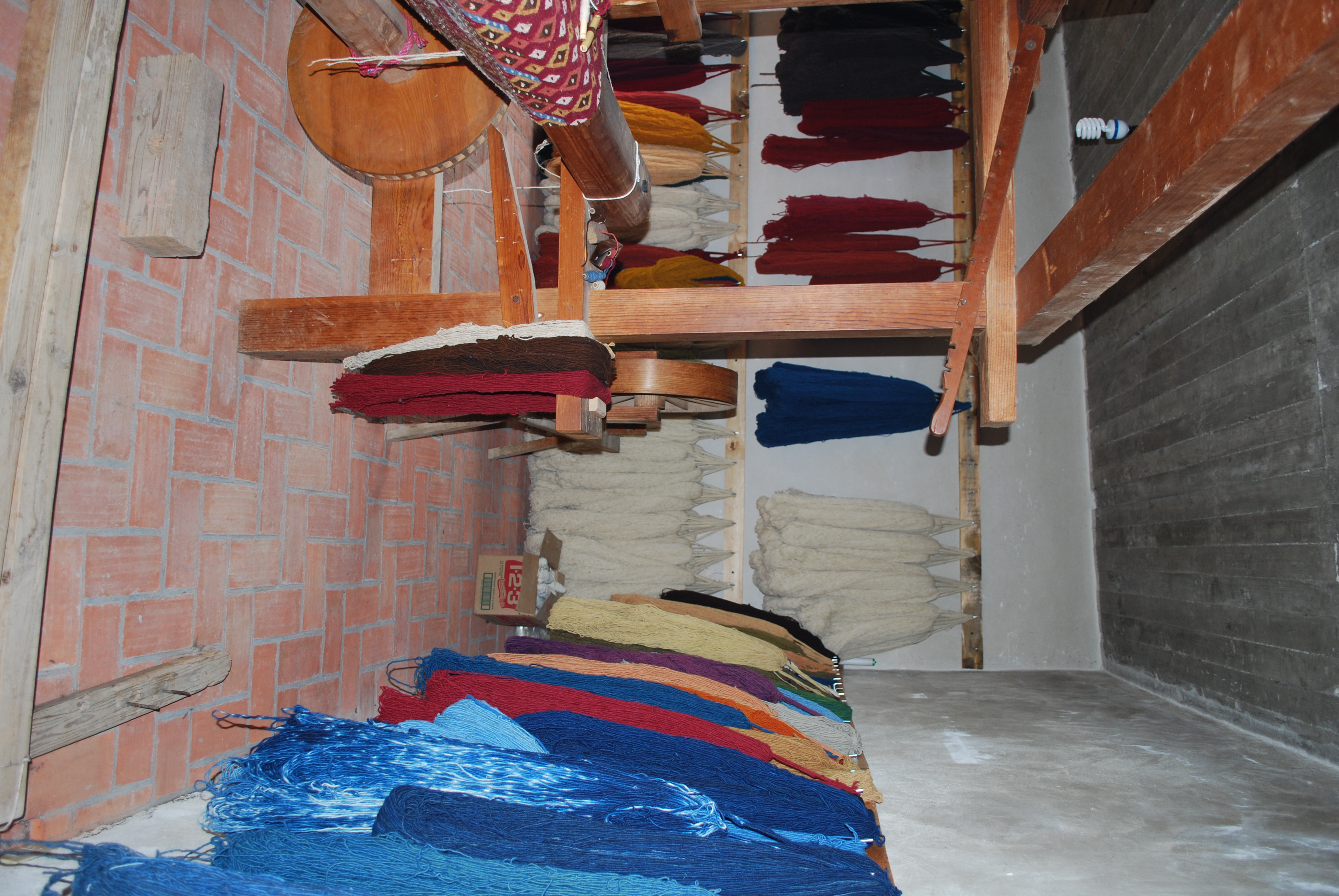
At Taller Teñido A Mano, a textile workshop, Elsa Sánchez and Eric Chávez describe sourcing cochineal, a red dye obtained from scale insects, from farms in Oaxaca and indigo, a plant-derived blue dye, from Santiago Niltepec. They also explain the preparation of wool and the time involved in making a rug. Their designs draw on inherited patterns while making space for landscape-inspired abstraction and experimentation.[3]
These practitioners offer specific accounts of their own methods. They should not be taken to represent a single rule followed by every Zapotec maker. Their differences are part of what makes the subject interesting: a shared cultural inheritance can support distinct artistic positions.
Continuity has room for invention
Mendoza’s interview makes that variation especially clear. He describes his father’s interest in a broad range of fibers and colors, including synthetic dyes, alongside his own renewed attention to regional natural dyes and ecological concerns.[1] An intergenerational relationship can carry both continuity and disagreement about materials, priorities, and possibilities.
For Folkly, this challenges a familiar idea of preservation: that a tradition remains authentic only while its outward appearance stays fixed. A more useful question is whether people retain the knowledge and freedom to make meaningful choices within it.

That shifts the focus from an isolated object to the conditions around its making. Time to learn, access to materials, recognition of skilled work, and a viable livelihood all matter. Admiration for a finished textile is a beginning. Understanding the practice means asking what allows its makers to keep working and what room they have to pursue their own ideas.
Color begins before the loom
Porfirio Gutiérrez's account places dye materials in a wider landscape, with knowledge about gathering and working with them carried through his family.[2] Thinking about color this way changes the apparent boundary of the workshop. The visible work at the loom depends on other forms of attention and preparation. A textile is connected to the things needed to make its materials usable, not only to the moment when those materials are woven.
Natural color does not arrive as a finished design decision simply because a plant or insect exists. It has to be obtained, prepared, and used. The distinction between a material and the knowledge required to work with it is central. Two people can begin with a similar resource without making the same result. Skill includes deciding what to do with variation, rather than expecting every batch to behave as an interchangeable industrial input.
That variability makes a useful question for a viewer: which qualities of the work come from a deliberate design, and which come from responding to the material? The answer need not divide technique from creativity. Responding well is itself a creative act. A maker can develop a recognizable practice through the way they manage constraints, much as a musician develops a voice through phrasing rather than simply possessing an instrument.
Inheritance leaves room for decisions
Gabriel Mendoza describes a family practice that combined inherited weaving knowledge with artistic experimentation. His museum interview presents natural and synthetic dyes as choices within that history, rather than placing every generation on one fixed path.[1] It is worth preserving that distinction. A living tradition can contain disagreement about materials while maintaining a shared commitment to the quality and expressive possibilities of the work.
The interview also makes family teaching visible. Learning can begin before a young person understands the full value of what they are seeing. A daily environment exposes them to standards, habits, and ways of solving problems. Later they may choose which of those practices to continue and which to change. Inheritance supplies a starting point; it does not remove the need for an individual to decide how to work.
This is why innovation should not automatically be treated as a break with cultural identity. A change can come from inside a practice, through someone who knows its possibilities closely. The relevant question is not simply whether an object looks old or new. It is whether the maker can exercise authorship, connect with the knowledge they value, and earn a living through the decisions they make.
A livelihood behind the pattern
The Tëñido a Mano project describes a workshop economy built around natural dyes and hand production.[3] A workshop's own account is useful for understanding its priorities, while remaining different from an independent measurement of income or environmental impact. Keeping those kinds of evidence separate lets us take a maker's stated ambitions seriously without turning every aspiration into a demonstrated result.
A buyer can ask practical questions without reducing the encounter to a checklist. Who made the piece? Which materials were used? How does the seller describe the relationship with the workshop? What does the price allow the maker to continue doing? These questions focus attention on the production relationship behind the object. A beautiful textile is also part of someone's working life, and recognition has more substance when that work can be named.
The broader challenge is continuity without confinement. A community needs opportunities for skilled work to remain viable, but its makers should not be expected to repeat one image of tradition forever. The cloth can carry memory and still make space for a new decision. In Teotitlán, that possibility is visible in the connection between material knowledge, family learning, and the individual hand that turns those resources into a particular piece.
Three accounts, three different questions
These accounts are most informative when read alongside one another without pretending their makers take one position on tradition. A comparison can show a real difference while leaving unmeasured claims about environmental benefit or earnings unresolved.
- Gabriel Mendoza's museum interview. Family learning includes experimentation with fibers and natural or synthetic colors. Which choices belonged to which generation? [1]
- Porfirio Gutiérrez's process account. Gathering and preparing dye material connects color to environmental variation. How does a particular batch affect the maker's decisions? [2]
- Teñido A Mano's workshop account. Sourcing cochineal and indigo is part of making a rug. What evidence would establish income or environmental outcomes? [3]
Use the loom and dye photographs for different questions. The loom shows how an object is constructed; cochineal identifies one material from which color may begin. Neither proves that a photographed rug uses that material. A maker's own process description supplies that connection. Ask who made the piece, what the maker says about its materials, and what is documented rather than inferring a sustainable supply chain from the appearance of handwork.

Sources & further reading
- Textile Museum of Canada. Gabriel Mendoza in Conversation with Julie McIsaac.
- Porfirio Gutiérrez. Natural Dyes: the process.
- Taller Teñido A Mano. Natural dyes, designs, and weaving practice.