Tui Emma Gillies grew up beneath her grandmother’s work. The walls and ceiling of her bedroom in Manurewa, South Auckland, were covered in ngatu made by Ema, her maternal grandmother. Her mother explained how the bark had been beaten into those large surfaces. Gillies remembered feeling protected in the room, long before she knew she would become an artist working with the same material. The Coconet interview1
Another family’s cloth travelled from Tonga to New Zealand for a child’s celebration. Mafi Tu’inukuafe Latu and ‘Anau Toili Latu made it in 1983 for Toili Latu’s fifth birthday and hair-cutting ceremony. Nearly six metres square, it is now in Te Papa’s collection. Its size records an exceptional amount of work for a very particular recipient. Te Papa2
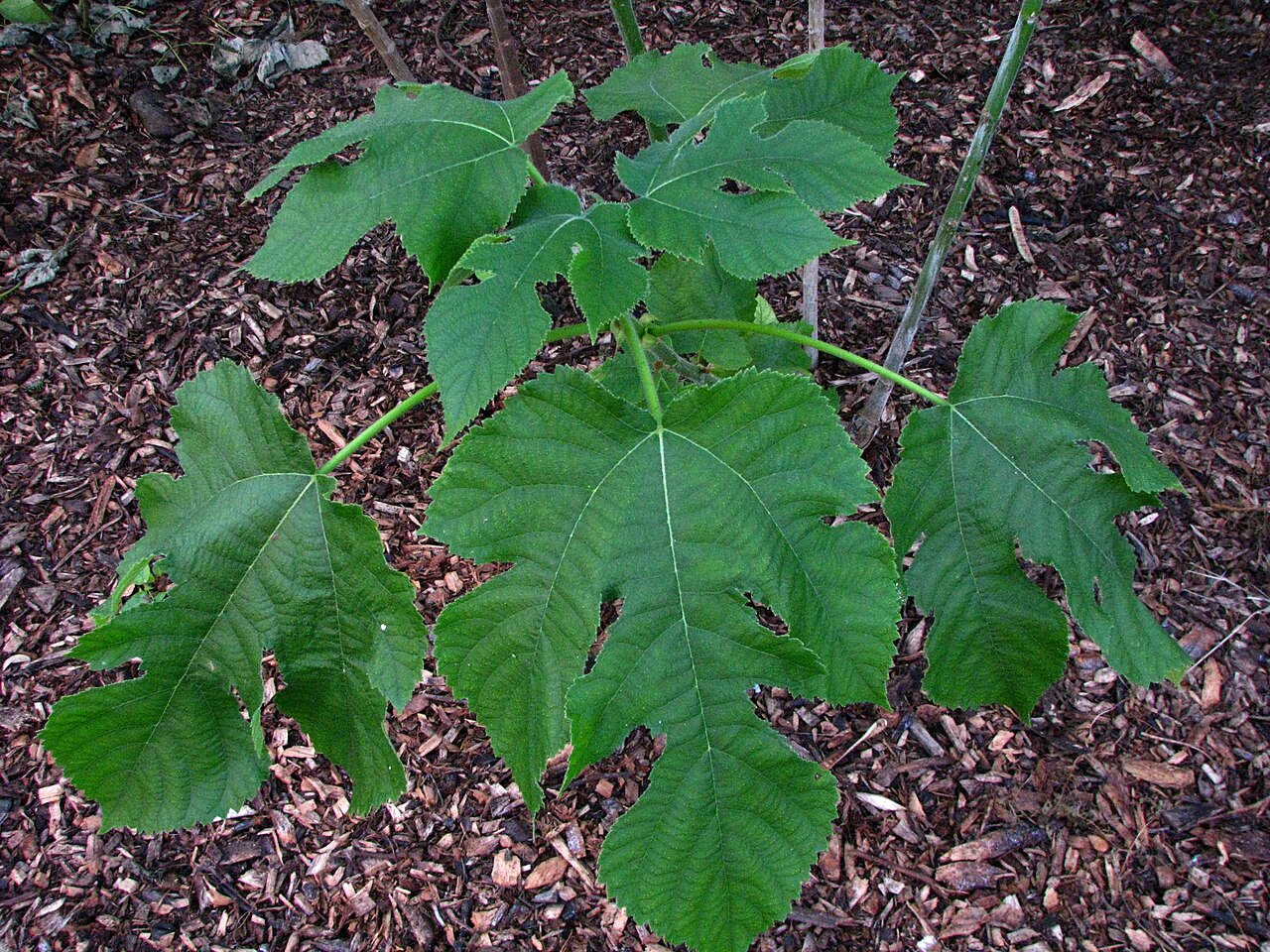
Ngatu is Tongan barkcloth, produced from the inner bark of hiapo, the paper mulberry tree. It is often described through the broader Pacific term tapa. Calling it cloth can lead an unfamiliar reader towards the wrong process: its surface is made by beating and joining bark, rather than weaving threads into a fabric.
The material begins narrow and becomes wide. The maker separates the useful bark, works it with a mallet, and prepares pieces that can be joined. Subsequent processes bring those pieces into a larger surface and give that surface a pattern. Te Papa’s account describes a sequence of preparation, imprinting with a kupesi pattern board, joining, and hand decoration. Te Papa on ngatu-making3
A child living with the finished surface may know it first as part of home. The process can be learned later: that someone worked the bark, joined the pieces, and chose where the pattern should fall. What felt like a room’s ordinary appearance becomes recognisable as a relative’s sustained effort.
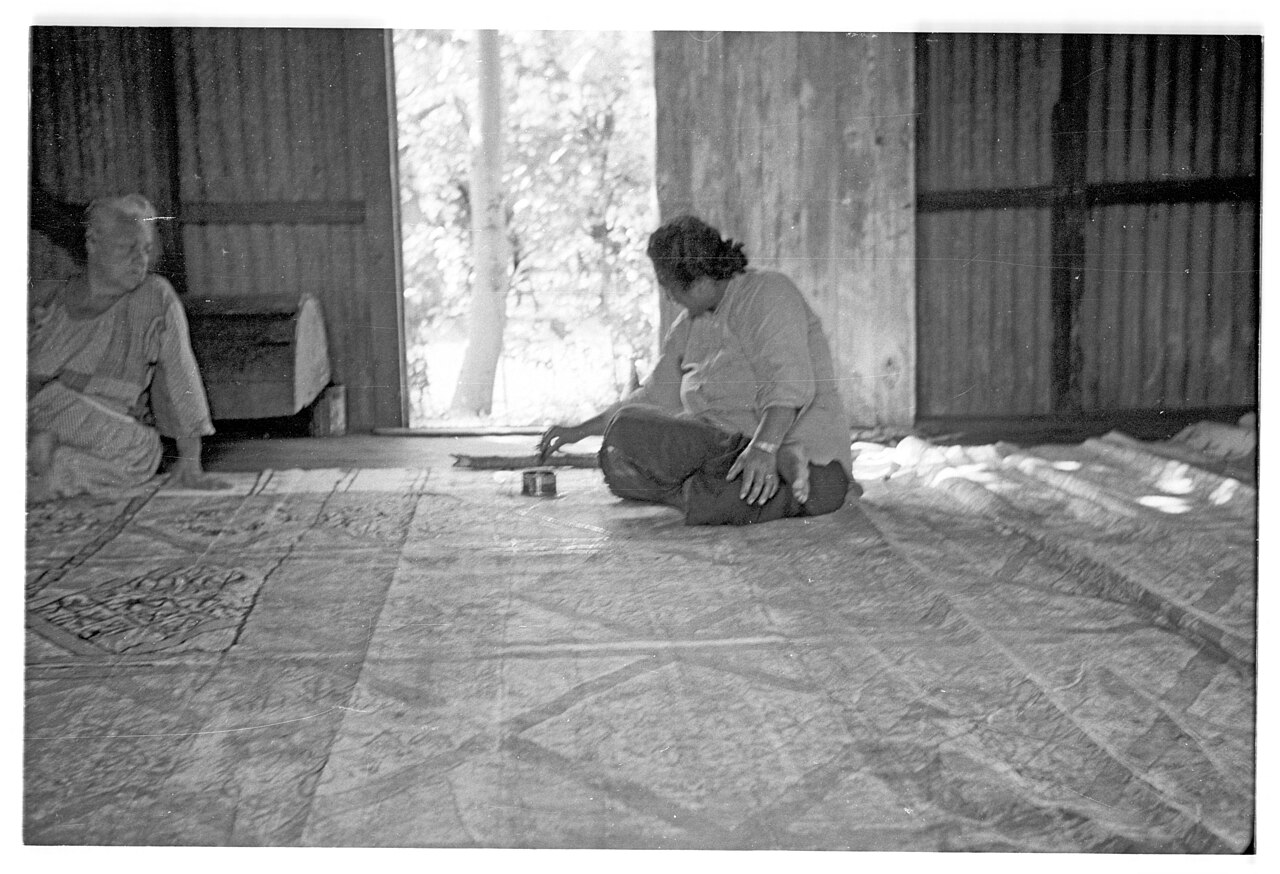
That work is collective. In the shared making process known as koka’anga, individual preparations become part of a larger cloth. Documentation from Tonga shows women working around a curved table, joining pieces and applying colour. The arrangement allows several hands to contribute to a continuous surface. ICHCAP’s account of ngatu4
The scale makes dependence visible. Nobody can be everywhere along the cloth. A participant must trust work completed beyond her own reach, and others must be able to trust hers. The large surface is the result of people accepting those small, repeated responsibilities to one another.
Te Papa describes partners passing prepared bark across the table, joining overlapping pieces, and rubbing dye over the surface to reveal a pattern underneath. Dividing lines and numbers mark langanga, units used to measure the cloth’s growing length. The process proceeds through repeated additions. Te Papa on decorating ngatu5
The numbers offer a different way to look at the textile. A visitor may follow a motif while a maker keeps track of how far the work has progressed. Beauty and accounting share the surface. The growing length can show both what has been achieved and what still needs doing.
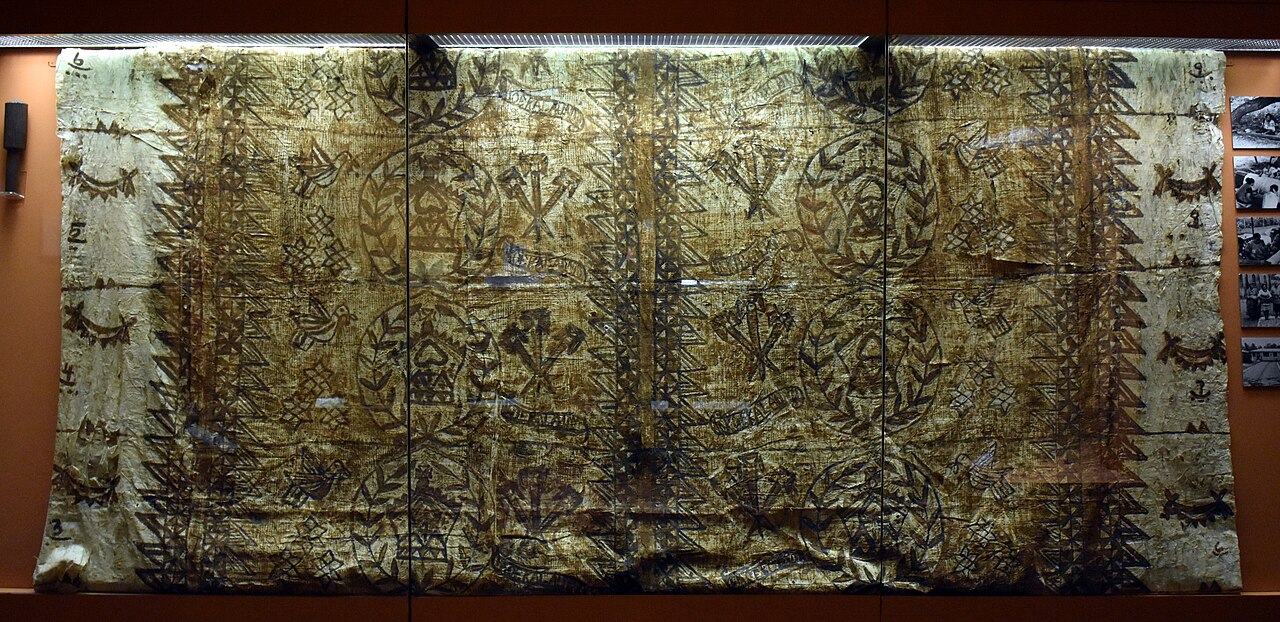
The method also allows a design to operate at several scales. A small repeated form establishes a rhythm; a larger arrangement gives the cloth its overall character. Looking closely and looking from a distance become different experiences of the same work.
The kupesi makes this possible without removing the hand. An impression supplies a pattern that can be reinforced and elaborated. Repetition and individual judgement remain together in the finished surface.
Familiar patterns can carry the memory of people as well as designs. A maker may value a form partly because she remembers who taught her to recognise it. Repeating it can feel like continuing a conversation, even when the person associated with it is no longer present.
Tongan artist Sulieti Fieme‘a Burrows described that relationship plainly at a 2023 gathering in Tahiti: “I keep doing my work because it reminds me of my parents.” She wanted to pass the capacity on to her daughter and granddaughter. Her account locates remembrance inside an action she can still perform. Te Papa6
A shared work session gives such teaching somewhere to happen. During a 2011 University of Auckland residency, Lolohea Tupouniua and the Oto‘ota Fahina Society demonstrated ngatu-making alongside food, singing, conversation, and stories. Tupouniua had learned from her mother in Tonga. She insisted that the work needed a group. University of Auckland7
Conversation does not have to wait until the useful work is finished. People can attend to the cloth and to one another in the same stretch of time. That is part of what a collective practice makes possible: a reason to meet that does not require anyone to arrive with a story worth telling.
The company can be sustaining, but gathering still has a cost. People need time, materials, a place to work, and arrangements that let them return. The care evident in the finished cloth begins with making those conditions possible. Calling the work communal should not make the contribution of any one woman seem effortless.
Nor should the family’s possession of a large piece obscure its makers. Wealth and respect may be associated with the cloth, but somebody supplied the hours that brought it into being. Naming her changes how the object is understood. It becomes possible to ask what she knew, whom she worked with, and what else she fitted around the task.
Recognising those makers changes the meaning of the gift. The recipient receives material, but also the result of organised effort. A large piece carries a visible commitment of time.
Ngatu circulates at weddings, funerals, and other important occasions. Te Papa describes that circulation as central to its social function. The cloth can mark a relationship through being given, rather than acquiring value solely by remaining in one person’s possession. Te Papa on ngatu and historical memory8
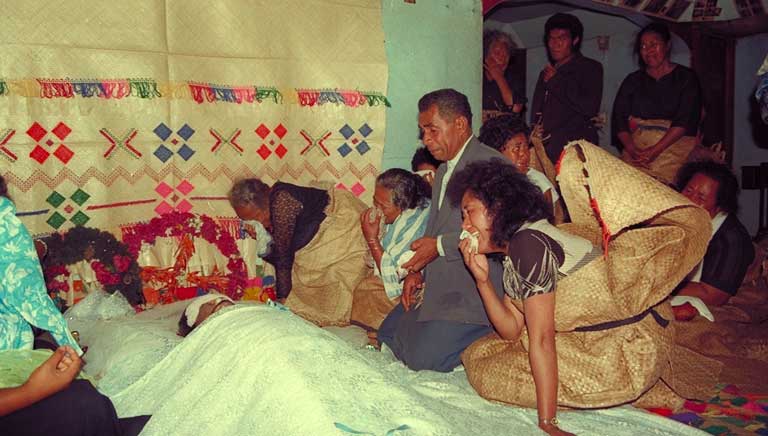
A valuable thing can therefore fulfil its purpose by leaving. Giving ngatu puts completed work into another family occasion, allowing the recipient to acknowledge relationships through its presence. Its departure need not mean an ending for the makers’ connection to it.
That is particularly clear when distance separates the people involved. The material can arrive in a room the makers will never see. Whoever unfolds it is handling the result of work performed elsewhere, for a reason that joins the two places. The gift makes a relationship take up physical space.
The textile can also record events. Te Papa documents ngatu featuring bicycles, gramophones, Halley’s Comet, and electric lamp posts, alongside other motifs. The lamp posts commemorate the arrival of electricity in a village. A form associated with inheritance has made room for technologies that were once new.
A lamp post seems a modest thing to carry into a design until one considers what the arrival of electricity changes in a household. The motif gives public history a domestic scale. Something that altered ordinary evenings can remain worth remembering long after the technology itself becomes unremarkable.
Nor does every motif have to become a universal symbol to matter. The value of a local reference may reside in recognition among the people for whom it was made. An outsider can appreciate the design while accepting that its fullest associations belong elsewhere.
The cloth for Toili’s birthday also belongs to that scale of history. Its occasion was a child getting older. The care invested in it does not require a national anniversary or a famous recipient. A family milestone was sufficient reason to make something substantial and send it across the ocean.
A collection record cannot recover every conversation around its making or every reaction at its arrival. But retaining the makers’ names and the purpose of the gift prevents the cloth becoming entirely anonymous. Those details keep a route open from the admired object back to the lives that gave it a reason to exist.
Migration extends those relationships across distance. Scholarship on Tongan women’s textiles in diaspora argues that cloth and fine mats help people maintain and reshape connections to fonua, homeland or nation, beyond the boundaries of the islands. The movement of valued things complicates the assumption that cultural life must remain geographically continuous. Research on Tongan textiles in diaspora9
Belonging was less straightforward. Gillies told The Coconet that her father discouraged her mother from teaching the children Tongan. Preparing for an aunt’s funeral at twenty-two drew her more deeply into her Tongan family.
That is one reason a family history cannot be read from decoration alone. A person may grow up surrounded by evidence of an inheritance and still have to find a route into it as an adult. The later return involves questions and choices that the child could not yet formulate.
Diaspora also changes the conditions of making. A group may have access to different materials, meeting spaces, and working schedules. The response can involve adaptation rather than simple reproduction.
The Wellington collective Ilo Me’a Fo’ou found another route through distance by making ngatu pepa from a manufactured textile material. Member Sokopeti Sina remembered the activity as a connection with home in Tonga. Te Papa’s account preserves her recollection of the group, which had ceased operating by the time of the 2014 article. A changed material had supported a familiar kind of gathering. Te Papa10
Gillies began collaborating with Sulieti in 2014. Her mother objected when she brought back poor-quality plain barkcloth to paint. In her Coconet account, learning meant coming to recognise what would satisfy a demanding maker.
That is a more intimate picture of transmission than an unbroken line on a family tree. Two people have to work together in the present. One may know more about preparing the material; the other may want to take an image somewhere unexpected. Their relationship has to accommodate both knowledge and the right to propose something new.
The same care applies to obligation. The expectation that women will provide cloth can carry pride, responsibility, and pressure together. An account that celebrates giving should remain interested in who has the resources to meet those expectations.
A gift can be generous and demanding. Those qualities are not mutually exclusive. The social importance of ngatu makes the labour behind it more consequential, and makes the distribution of that labour worth noticing.
Their 2022 work The Last Kai, shown by Tautai in 2023, used the familiar composition of the Last Supper to ask about women’s place at the table. Another work put a woman on the cross. Barkcloth, inherited religious images, and contemporary questions occupied the same surface. The exhibition presented a discussion between generations, carried through their collaboration. Tautai Pacific Arts Trust11
The images give inheritance the capacity to ask difficult questions. Respect for a material and the people who taught it need not require agreement with every expectation attached to domestic life. A daughter and mother can use what they share to make room for an argument.
A younger participant watching such work encounters more than a technique. She sees that a familiar form can hold a present concern, that an older maker can collaborate in a new proposition, and that family connection does not depend on every generation producing the same image.
Teaching then becomes a gift with an uncertain destination. The next person may use the skill in ways the teacher could not have predicted. The ability survives because it becomes available to another judgement. A living practice needs that risk as well as the reassurance of recognisable work.
The title’s family history lives in those layers without being fully explained by them. Some of it can be named: a maker, an occasion, a departure. Some remains in what a relative remembers about the room, the gathering, or the person whose hands prepared the surface.
Sulieti’s reason for continuing is also a reason to teach: the work reminds her of her parents, and she wants the next generation to carry it. A cloth can leave the family, cross an ocean, or enter a museum. The capacity to make another stays alive in someone’s hands.
Read the object record before reading the motif
The named birthday cloth, descriptions of collective making and the artists' collaboration supply different routes into ngatu. Their details become more useful when the object, maker and occasion stay attached. A generic festival-stall photograph cannot substitute for the catalog record of a particular gift.
- Toili Latu's birthday cloth record. Named makers, 1983 occasion and movement between Tonga and New Zealand. Not every conversation around the gift is recoverable. [2]
- Te Papa's making descriptions. Prepared bark, joining and kupesi-related decoration. Ngatu is not woven ta‘ovala. [3]
- Gillies and Burrows's exhibition. A shared material can hold a new argument between generations. Inheritance does not require identical images. [11]
Look for a numbered division or a repeated motif, then ask which meaning the source actually documents. Some marks record production and scale; some refer to events or relationships. Where an association is unknown, leave it unknown. A careful object description can be revealing without claiming access to a family's full history.