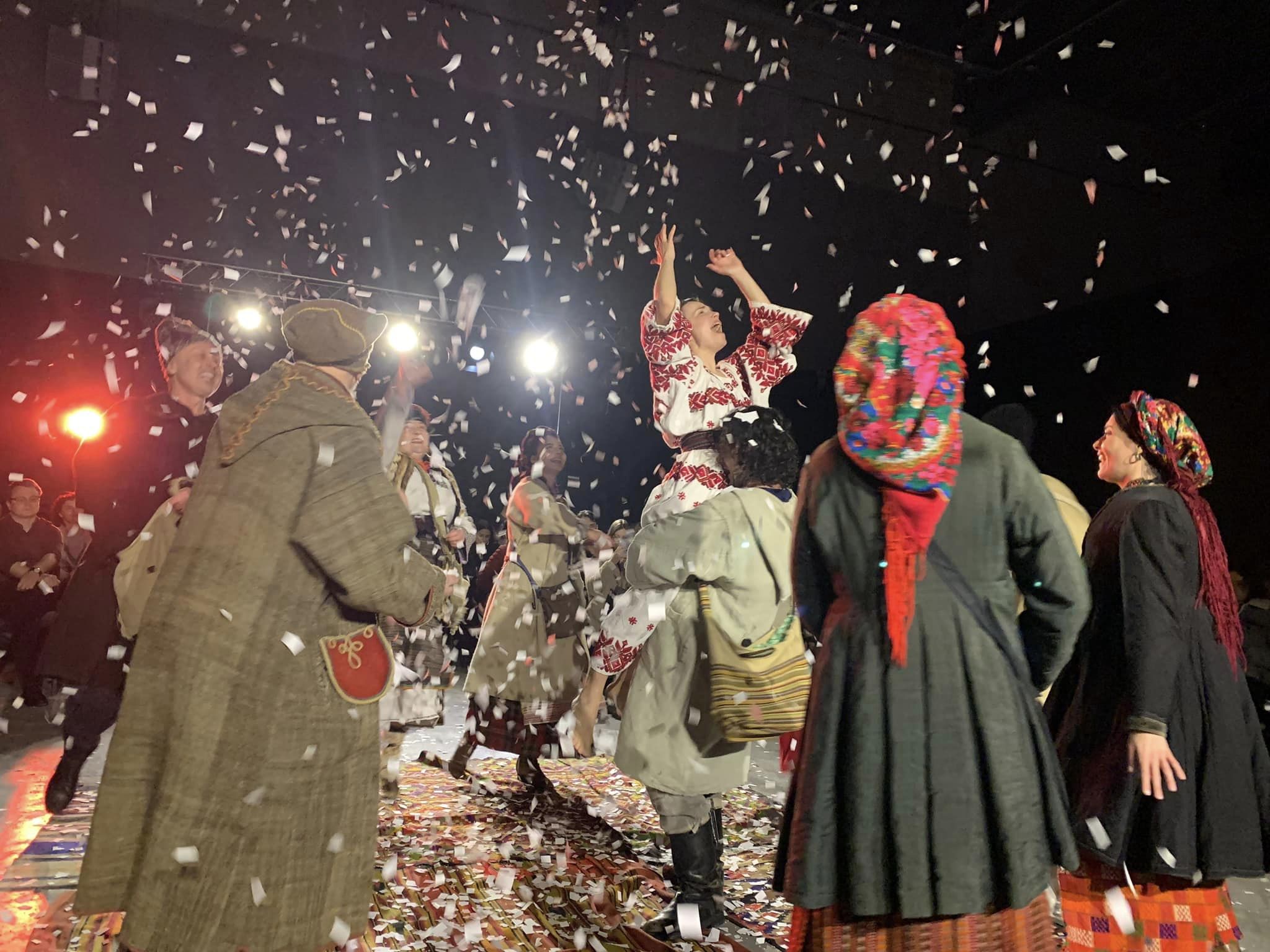
Olena Vdovychenko still dressed for the theater.
In an August 2024 interview with Deutsche Welle, the Kyiv theatergoer described choosing a dress, putting on makeup, and wearing perfume. These preparations gave her an occasion to look forward to during the war. Getting a ticket could require preparation of another kind: watching for an announced release and being ready to book.
There was one thing she could not arrange. An air raid alert might interrupt the performance or lead to its cancellation. She had already experienced that disappointment.1
The detail about perfume makes the story especially human. A night at the theater begins before anyone steps onstage. It can begin with choosing how to appear in public, with anticipation, or with deciding that an evening deserves a little ceremony.
Vdovychenko’s account helps explain why theater has drawn such attention during Russia’s full-scale war against Ukraine. For some audiences, it offers a form of shared experience they actively make room for, even when the conditions are uncertain.
The renewed demand is real in documented parts of the theater world. Its meaning becomes clearer when we look beyond the headline about sold-out seats.
What a crowded auditorium can tell us
In August 2024, NPR reported that The Witch of Konotop had filled the Ivan Franko National Theater’s nearly 800-seat auditorium for every performance that summer, according to the theater’s press liaison. Tickets were difficult to obtain, and clips from the production had spread widely on social media.2
Those details offer solid evidence of one production’s remarkable popularity. They also suggest how a stage performance reaches people who are not yet regular theatergoers. A short clip can make a person curious; the next step is finding a seat.
A scholarly article on Ukraine’s theater revival in the 2023–24 season likewise describes renewed audience interest, especially in Kyiv, while considering the pressures of war on artists and institutions.3
It would take broader, comparable data to turn those observations into a precise national growth rate. The available accounts are more useful when kept close to their locations and dates.
A full house at the Franko tells us something significant about Kyiv. It does not tell us that every company can fill its seats, or that the country’s theaters face the same conditions.
The interesting story is in that unevenness: extraordinary enthusiasm existing alongside interruption, displacement, and loss.
A witch with a long backstory
Directed by Ivan Uryvskyi, the Franko’s The Witch of Konotop premiered on April 28, 2023. It adapts a nineteenth-century story by Hryhorii Kvitka-Osnovianenko, bringing an established Ukrainian literary work into a contemporary theatrical language.
The theater’s own description explains that Uryvskyi wanted a different mood after staging Albert Camus’s Caligula. He was interested in a comedy that could bring light while still prompting thought.
The production’s credits reveal how many kinds of artistry support that result: Tetyana Ovsiichuk’s set and costume design, Susanna Karpenko’s composition and vocal arrangements, and Olha Semioshkina’s choreography are among its essential components.4
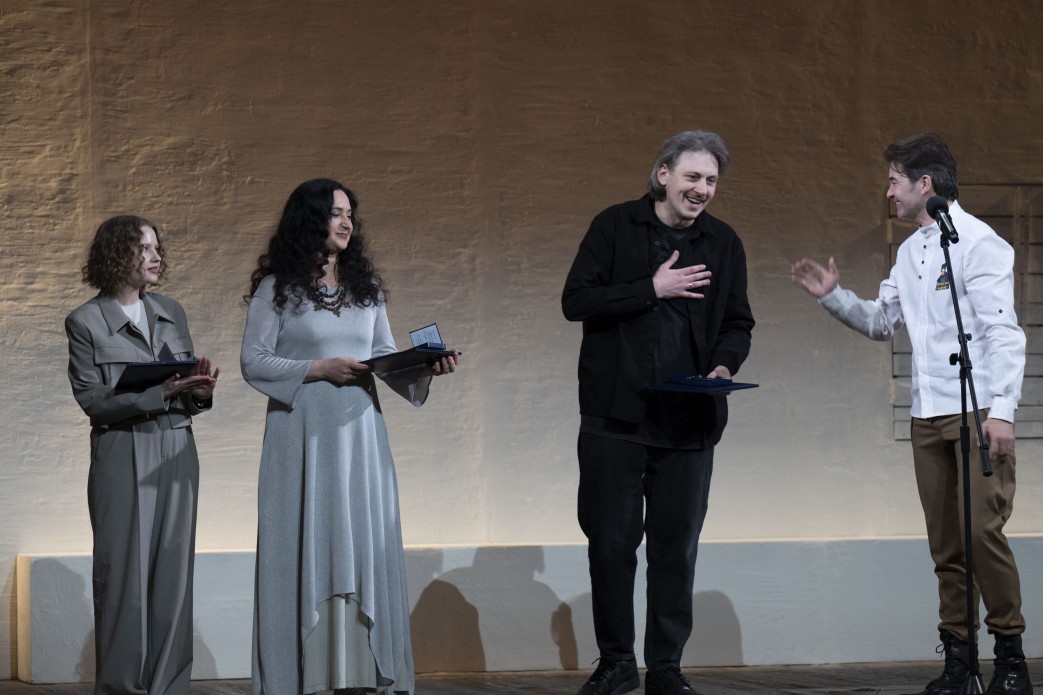
Naming those collaborators helps move the conversation beyond the idea of a hit emerging from national feeling alone. Someone has to make decisions about what the audience sees and hears. A familiar story still needs a theatrical form.
NPR’s account describes a commander who tries to enlist a witch’s help in making a woman love him. Audience member Markian Halabala understood the play partly through its warning against interfering with another person’s destiny. Another theatergoer, Olha Vasylevshka, emphasized love and the futility of trying to manufacture it.2
Those different responses are part of the pleasure. People can sit in the same auditorium and leave carrying different parts of a story.
The play offers a shared reference point without requiring an identical reading. One person may follow the comedy; another may be drawn to the misuse of power. The conversation afterward becomes another part of the evening.
The audience has met experimentation before
The willingness to remake older material belongs to a long history of Ukrainian theater.
Les Kurbas, born into an acting family in 1887, became one of its most influential experimenters. After studying in Vienna and Lviv, he worked as an actor and director and established the Berezil artistic association in Kyiv in 1922.
Berezil developed an ambitious system of training and experimentation, including acting studios and a directors’ laboratory. Kurbas brought movement, speech, music, light, and visual design into carefully structured relationships.5
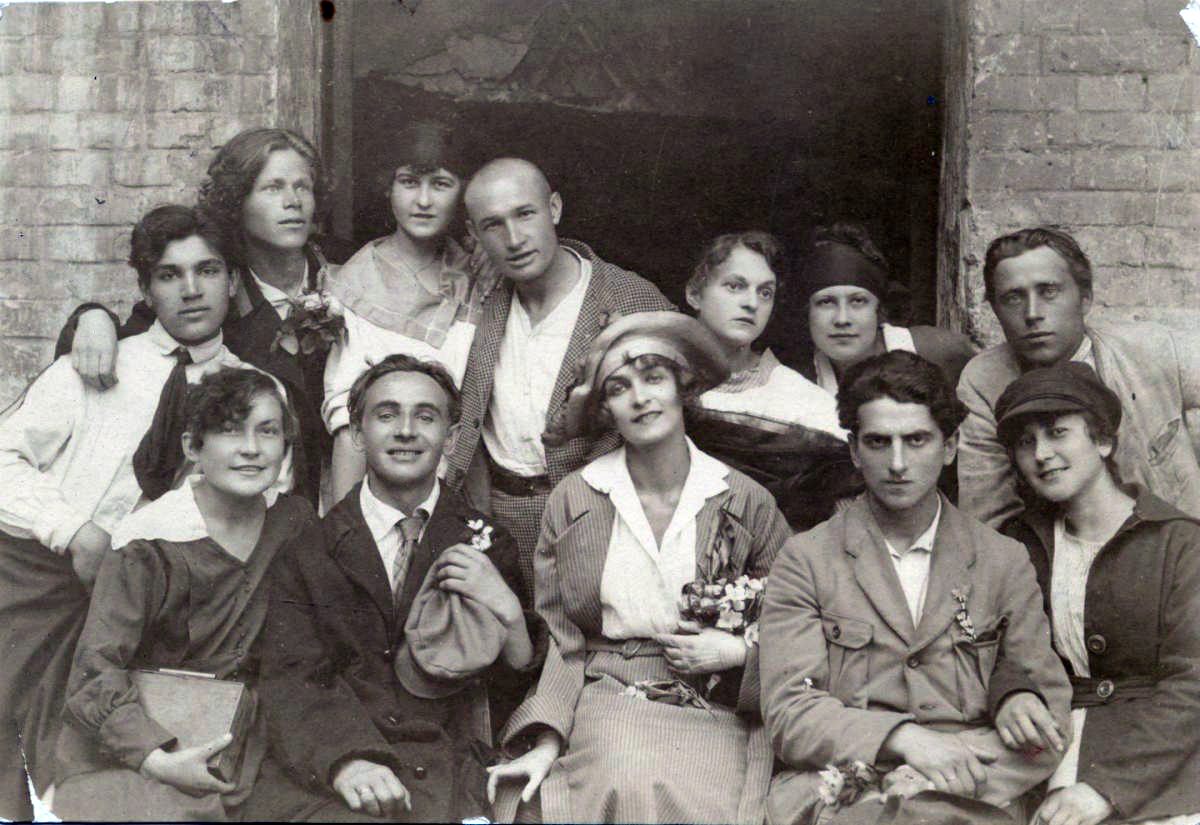
For a contemporary reader, this is a useful correction to the assumption that Ukrainian cultural history can be approached only through folk dress, village songs, and rural scenes. Those traditions are important, but they belong alongside demanding urban experiments in how art could work.
Kurbas wanted audiences to do more than follow a plot. His productions asked them to notice how a performance made meaning.
The Open Kurbas archive describes a striking choice in his 1924 Macbeth: actors entered as themselves and became their characters in front of the audience. It also documents his collaborations with designer Vadym Meller, whose structures created multiple levels and angles for action.
In 1929, Berezil presented Hello, This Is Radio 477!, a jazz musical revue imagining Kharkiv in conversation with contemporary European life.6
These examples make the period feel less remote. An audience could encounter Shakespeare, abstract stage structures, new media, and popular music within the same wider theatrical world.
The impulse to combine forms did not arrive in Ukraine with the latest international trend. Local artists were already testing what a stage could contain a century ago.
A history with difficult audiences and state repression
Experimentation did not always win applause.
After Berezil moved to Kharkiv in 1926, its opening production of Fernand Crommelynck’s Golden Guts met resistance from audiences and political authorities. Open Kurbas’s history describes a theater negotiating artistic ambitions, demands for popular entertainment, and increasing official pressure.
That pressure became destructive. Kurbas was removed from the theater’s leadership in 1933, and Berezil was renamed in 1935.7
Kurbas was executed in 1937 during Stalin’s terror.5
His work is worth remembering for the ideas as well as the violence that cut his life short. To know only that an artist was persecuted is to miss the art that made the artist matter.
The surviving models, photographs, and production records help recover choices that would otherwise remain abstract: the arrangement of a set, the relationship between performers, a director’s decision about when illusion should begin.
They also preserve a history of difficulty. Some productions failed to find their audience. Some audiences resisted unfamiliar work. A living theater culture includes disagreement and risk, not only unanimous admiration.
That is useful context for today’s revival. Its significance includes the freedom to attempt something strange, to be funny, to unsettle a viewer, or to make a work whose value is not immediately settled.
Four women at a border
Contemporary Ukrainian playwrights are also making new work from experiences that older scripts cannot contain in the same way.
Natalka Vorozhbyt’s Green Corridors, written in 2023, follows four women who meet at the border between Ukraine and the rest of Europe. The Ukrainian Institute’s drama library describes a tragicomedy about their subsequent lives and relationships, using absurdism and dark humor that sometimes approaches the surreal.
The English translation is by John Freedman and Natalia Bratus.8
That combination of displacement and comedy is worth pausing over. People who leave a war do not lose their differences, contradictions, or capacity to be irritated by one another. A play can allow those qualities to remain visible.
The women are characters in relationships, rather than examples placed in a report. The form allows a writer to explore what people misunderstand about each other and what happens when an apparently generous encounter becomes complicated.
In January 2026, Green Corridors received its American premiere at Chicago’s Trap Door Theatre, directed by Kay Martinovich.9
A production abroad creates another kind of meeting. Actors, translators, and audiences have to work with a story whose circumstances may be unfamiliar to them.
The translation credits belong in that account. A play travels through decisions about rhythm, idiom, humor, and voice. Those decisions help determine whether a character reaches a new audience as a complicated person.
An old epic, different bodies
At a Veterans’ Theatre rehearsal in Kyiv in November 2025, writer Brandice Thompson watched performers working on Eneida. Her account, published in American Theatre in June 2026, describes veterans rehearsing with a young women’s chorus.
The studio allowed performers to work without prosthetics when needed. After rehearsal, a veteran who made musical instruments brought out a hurdy-gurdy he had adapted for use with his prosthetic arm. Others joined in singing.10
The choice of Eneida brings another layer of cultural history into the room.
Ivan Kotliarevsky’s poem reworked Virgil’s Aeneid through a Ukrainian comic world. Its first three parts appeared in 1798. Written in the language of everyday speech, it became a landmark in the development of modern Ukrainian literature, using satire and richly idiomatic language to describe social life.11
An inherited text is therefore meeting performers with particular physical needs and contemporary experiences. The rehearsal makes adaptation literal: bodies, choreography, and instruments have to work together.
The result deserves attention as artistic labor. A performer is learning timing, finding a way through movement, or discovering how a voice belongs in an ensemble.
Recognizing those skills allows a veteran to appear as an artist with choices to make. The war is part of the person’s life, but it does not have to become the only thing an audience is able to see.
A different story near the front
The phrase “theater boom” becomes less adequate as we move away from the most visible successes.
In July 2025, Ukrainian reporting documented another Russian strike on the Mykola Kulish theater in Kherson. Its facade was damaged; no injuries were reported in that incident. The institution has run the Melpomene of Tavria theater festival since 1999 and continued working in other Ukrainian cities after the full-scale invasion.12
A theater is also a company, a repertoire, and a network of relationships. Those can continue in altered forms even when using the familiar building becomes difficult.
Continuity still comes with losses. A performance moved elsewhere reaches a different audience. A resident who once knew the route to the theater may no longer have access to the same cultural life.
Even within Kyiv, attendance can change sharply. Maskam Rad artistic director Inna Goncharova told Thompson that audiences were sparse after nights of heavy bombardment and fuller after quieter nights.10
That observation puts the audience back into the conditions of daily life. An empty seat may reflect exhaustion, fear, or a disrupted night.
The fuller account of Ukrainian theater holds both images: people trying hard to obtain a ticket and people who cannot make it through the door that evening.
The pleasure of being an audience
What, then, makes theater worth including in a series about Ukrainian cultural life during the war?
The answer emerges from the range of work. A nineteenth-century comic story becomes a contemporary hit. An experimental director’s archive opens a window onto the 1920s. A new play gives displaced women conflicting voices. Veterans bring an old literary work into a rehearsal shaped by their own bodies.
These stories show people using a cultural inheritance and adding to it. There is preservation here, but there is also disagreement, invention, and the desire to make a good night at the theater.
For audiences, the experience can have several meanings at once. Someone can feel solidarity with the performers and enjoy a joke. Someone can seek a break from daily pressure and encounter an uncomfortable thought.
The audience does not need to be reduced to a symbol of courage. It can remain a gathering of people with different tastes, expectations, and reasons for attending.
That brings us back to Vdovychenko choosing her dress and perfume. The preparations make a claim on an evening: this experience deserves attention.
When the performance can proceed, actors and audience spend that time together. A line lands. A response moves through the room. For a while, something made by other people becomes the thing everyone is watching.
During war, the opportunity is precarious. Its value is also wonderfully ordinary: people still want stories, company, surprise, and a reason to leave the house feeling glad they came.
A guide to four different theater encounters
The examples in this story are not four measurements of one nationwide boom. They concern different kinds of work, audiences and historical evidence. Use the production and publication dates to distinguish an artistic example from a current booking recommendation.
| Work or archive | What to follow | Limit |
|---|---|---|
| The Witch of Konotop | The named creative team and the theater's production account. | Reported 2024 demand does not measure all theaters. [4] |
| Open Kurbas | Records of experiments in staging and design. | An archive documents surviving evidence, not a live performance. [6] |
| Green Corridors | Translation, characters and the work's movement abroad. | The cited premiere is a dated event, not today's schedule. [8] |
| Veterans' Theatre rehearsal | How performers and equipment accommodate particular bodies. | A reported rehearsal is not a clinical outcome study. [10] |
This range is the article's stronger claim. The cultural life described includes comedy, experiment, translation and rehearsal, as well as interruption. No single full auditorium can represent that range, and no wartime example should reduce its artists to symbols instead of people making artistic choices.
Sources and further reading
A researched cultural essay based on the linked sources. No original interviews or firsthand reporting are claimed.